Have you ever wondered whether the correct expression is knick of time or nick of time? These phrases sound almost identical, so it’s easy to mix them up when speaking or writing. However, only one is the standard English expression: nick of time.
It means doing something just before it’s too late or arriving at the last possible moment. For example, “We reached the airport in the nick of time before the gate closed.
” The word “knick” is not correct in this idiom, even though some people mistakenly spell it that way. Understanding the difference can help you avoid a common spelling mistake and use the expression confidently.
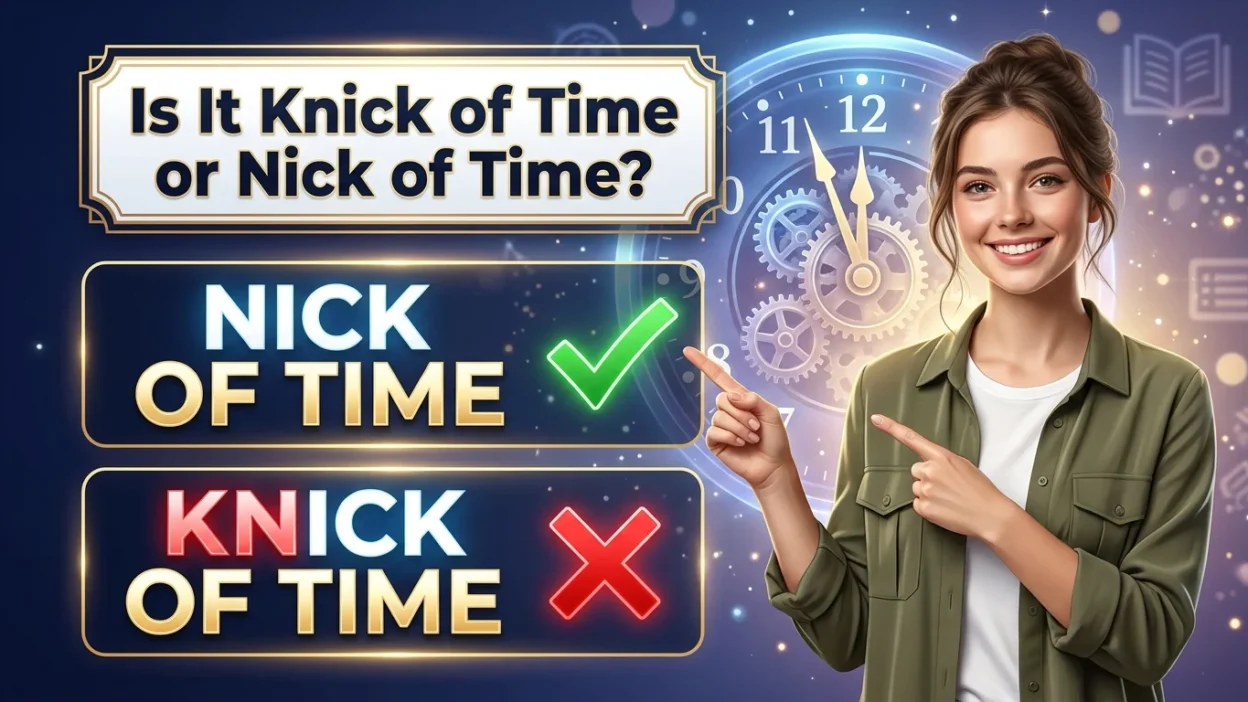
Quick Answer: Is It Knick of Time or Nick of Time?
The correct phrase is “in the nick of time.”
“Knick of time” is a spelling mistake when you mean that something happened just before it was too late.
| Phrase | Correct? | Meaning |
| In the nick of time | ✅ Yes | Just before it is too late |
| In the knick of time | ❌ No | Incorrect spelling |
| At the nick of time | ❌ Usually incorrect | Not the standard expression |
| In nick of time | ❌ Incorrect | Missing the article the |
The standard expression is:
in the nick of time
You should remember the complete phrase rather than trying to build it word by word.
What Does “In the Nick of Time” Mean?
“In the nick of time” means just before the latest possible moment or just before something bad or unwanted happens.
It often describes an action that happens with very little time left.
For example:
The firefighters arrived in the nick of time.
The sentence suggests that the firefighters arrived just before the situation became much worse.
Another example is:
She submitted her application in the nick of time.
This means she submitted the application just before the deadline.
The phrase often creates a sense of urgency. There was not much time left, but the person still managed to do what was necessary.
Simple Definition
A simple way to understand “in the nick of time” is:
Just in time, at the last possible moment.
For example:
- The doctor arrived in the nick of time.
- We caught the bus in the nick of time.
- He paid the bill in the nick of time.
- They escaped in the nick of time.
In each example, something happened shortly before it would have been too late.
Why Is “Nick” Correct Instead of “Knick”?
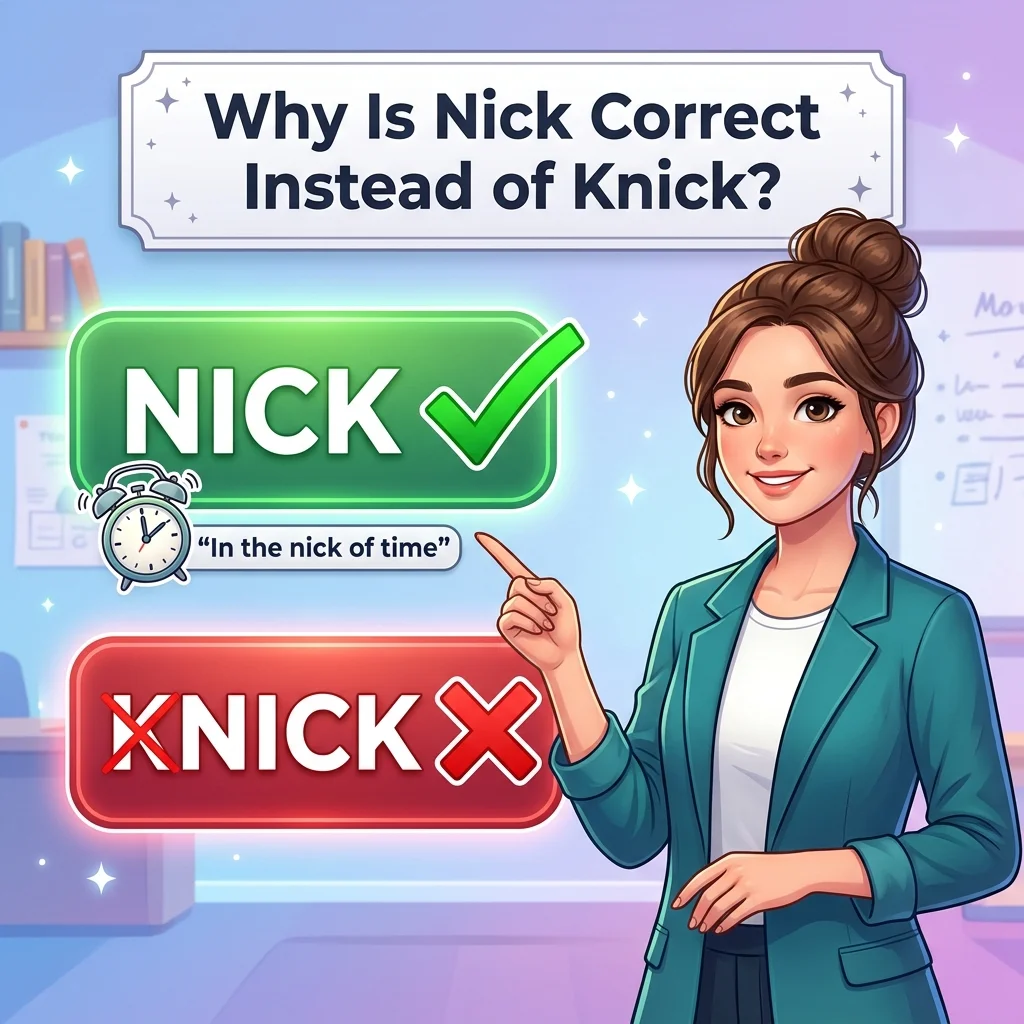
The confusion happens because nick and knick have different meanings and spellings.
In the phrase “in the nick of time,” the correct word is nick.
The spelling is:
N-I-C-K
There is no K after the first letter.
The word knick is not the word used in the standard expression.
So if you are writing an email, essay, article, message, or social media post, use:
in the nick of time
not:
in the knick of time
A Simple Spelling Trick
Think of the phrase as:
NICK = Nearly In the Critical Kick-off
This is only a memory trick, not the actual origin of the phrase. It can help you remember that nick has no extra k.
Another easy trick is to memorize the phrase as one fixed expression:
in + the + nick + of + time
Once you learn it as a complete phrase, the spelling becomes easier.
What Is the Difference Between “Nick” and “Knick”?
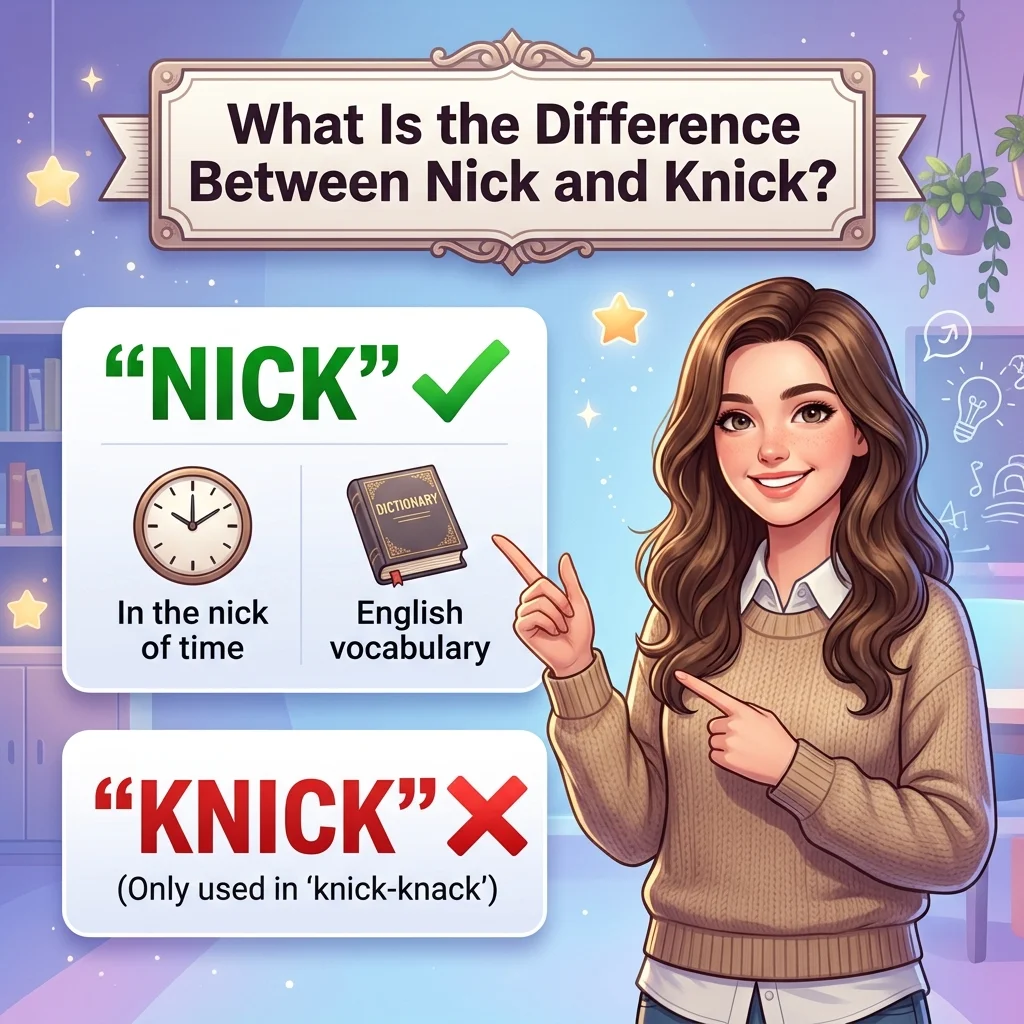
The words nick and knick can cause confusion because English contains many words with similar sounds.
However, they are not interchangeable.
Nick
Nick is a real English word with several meanings.
As a noun, it can mean a small cut, notch, or indentation.
For example:
There is a small nick in the table.
It can also appear in several expressions, including:
in the nick of time
In this expression, nick is part of an established idiom.
Knick
Knick is not the correct spelling for the word in “in the nick of time.”
You may see knick in other contexts, especially in words such as knick-knack, but you should not use it in the phrase about doing something just before it is too late.
For example:
❌ We arrived in the knick of time.
Correct:
✅ We arrived in the nick of time.
What Is the Meaning of “Nick” in This Phrase?
The meaning of nick in “in the nick of time” is connected to the idea of a particular point or moment.
The phrase developed historically, and its exact origin is not completely certain. Dictionaries commonly explain “nick” in this idiom as referring to a critical or precise moment.
You do not need to know the historical background to use the phrase correctly, though.
For everyday English, simply remember:
in the nick of time = at the last moment before it is too late
For example:
I woke up in the nick of time to catch my flight.
The speaker woke up just early enough to catch the flight.
“In the Nick of Time” vs. “Just in Time”
These two expressions are very similar, but they can have slightly different feelings.
“Just in time” means something happened early enough to meet a need or avoid being late.
“In the nick of time” usually emphasizes that the timing was extremely close.
Compare these sentences:
I arrived just in time for the meeting.
This means the speaker arrived before the meeting started, perhaps only a few minutes early.
Now consider:
I arrived in the nick of time to stop the door from closing.
This creates a stronger sense of urgency. The speaker arrived at almost the last possible second.
| Expression | Basic meaning | Feeling |
| Just in time | Early enough | Neutral |
| In the nick of time | Just before it is too late | More dramatic |
| At the last minute | Very late in the available time | Often suggests delay |
| At the last moment | Very close to the deadline or event | Neutral to urgent |
Example
We got to the airport just in time.
This sounds normal and practical.
We got to the airport in the nick of time.
This suggests that getting there was a close call.
“In the Nick of Time” vs. “At the Last Minute”
Another common comparison is “in the nick of time” and “at the last minute.”
They can describe similar situations, but they are not always interchangeable.
At the last minute often focuses on when someone did something.
For example:
He booked his hotel at the last minute.
This suggests that he waited until very late to make the booking.
In the nick of time focuses more on successfully doing something before it becomes impossible or too late.
For example:
He booked the hotel in the nick of time.
This suggests that he booked it just before the available rooms were gone or just before he needed accommodation.
Correct Grammar of “In the Nick of Time”
The phrase normally appears as:
in the nick of time
The preposition in is important.
The article the is also important.
The noun nick comes between the and of time.
The standard structure is:
in + the + nick + of + time
Correct Examples
She arrived in the nick of time.
We finished the project in the nick of time.
The ambulance came in the nick of time.
He remembered the deadline in the nick of time.
Incorrect Examples
❌ She arrived at the nick of time.
❌ She arrived in nick of time.
❌ She arrived in the knick of time.
❌ She arrived on the nick of time.
The standard idiom is in the nick of time.
Examples of “In the Nick of Time”
The best way to understand an idiom is to see it in different situations.
Example 1: Catching a Bus
I reached the bus stop in the nick of time.
The person arrived just before the bus left.
Example 2: Meeting a Deadline
We completed the report in the nick of time.
The report was completed just before the deadline.
Example 3: Avoiding an Accident
The driver stopped in the nick of time.
The driver stopped just before an accident could happen.
Example 4: Catching a Flight
They arrived at the airport in the nick of time.
They arrived just before they would have missed their flight.
Example 5: Saving Someone
The lifeguard reached the swimmer in the nick of time.
The lifeguard arrived just before the situation became more dangerous.
Example 6: Submitting Homework
I submitted my assignment in the nick of time.
The assignment was submitted just before the deadline.
Example 7: Avoiding a Problem
She noticed the mistake in the nick of time.
She noticed it before the mistake caused a bigger problem.
Example 8: Arriving for an Event
We got there in the nick of time to see the opening performance.
They arrived just before the performance began.
“In the Nick of Time” in Everyday Conversation
This phrase works well in casual conversations.
For example, imagine your friend arrives at a restaurant just before everyone orders.
You might say:
You made it in the nick of time!
This means your friend arrived just before the important moment.
Another example:
I found my passport in the nick of time.
This means the speaker found the passport just before they needed it.
The phrase can also make a story more interesting:
I was about to leave without my wallet, but I noticed it on the table in the nick of time.
Here, the expression adds a sense of urgency and relief.
Is “Knick of Time” Ever Correct?
When you mean “just before it is too late,” no.
The standard phrase is:
in the nick of time
Therefore, “knick of time” should be treated as a spelling error.
You may encounter “knick of time” online because people sometimes spell phrases based on how they sound. However, frequent mistakes do not make the spelling standard.
If you are writing professionally or academically, always use nick.
Why Do People Spell It “Knick of Time”?
There are several reasons for this common mistake.
First, nick and knick can sound similar in certain contexts.
Second, English has many words beginning with kn, such as:
- know
- knee
- knife
- knock
- knot
- knight
- knit
- knack
Because kn- appears in many English words, some people may naturally assume that “knick” is the correct spelling.
However, nick is the correct spelling in the idiom.
There is also the word knick-knack, which can make the spelling more confusing.
The key is to learn the phrase separately:
in the nick of time
Common Mistakes With the Phrase
Learning the correct spelling is only part of the process. English learners also make mistakes with the preposition, article, and sentence structure.
Mistake 1: Writing “Knick of Time”
Incorrect:
❌ We arrived in the knick of time.
Correct:
✅ We arrived in the nick of time.
Remember that nick has only one k.
Mistake 2: Leaving Out “The”
Incorrect:
❌ We arrived in nick of time.
Correct:
✅ We arrived in the nick of time.
The phrase normally requires the.
Mistake 3: Using “At”
Incorrect:
❌ She arrived at the nick of time.
Correct:
✅ She arrived in the nick of time.
The fixed idiom uses in.
Mistake 4: Using “On”
Incorrect:
❌ He finished the work on the nick of time.
Correct:
✅ He finished the work in the nick of time.
Again, the standard preposition is in.
Mistake 5: Using “Nick Time”
Incorrect:
❌ I reached there in nick time.
Correct:
✅ I reached there in the nick of time.
The complete phrase is important.
Is “In the Nick of Time” Formal or Informal?
“In the nick of time” is a standard English idiom. You can use it in both casual and reasonably formal writing.
However, the tone can feel slightly more expressive than the simple phrase “just in time.”
For example:
The team completed the project just in time.
This sounds straightforward.
The team completed the project in the nick of time.
This sounds more dramatic and emphasizes how close the deadline was.
For formal academic writing, “just before the deadline” may sometimes be clearer.
For storytelling, conversation, journalism, and general writing, “in the nick of time” can sound natural.
Can You Use “In the Nick of Time” for Future Events?
Usually, the phrase describes an action that happens at or near the critical moment. It can appear in sentences referring to future possibilities, but the most natural use is often with completed or expected actions.
For example:
I hope we arrive in the nick of time.
This is grammatically possible and means the speaker hopes to arrive just before it is too late.
You can also say:
They may reach the station in the nick of time.
The phrase can therefore work with different verb tenses depending on the context.
“In the Nick of Time” in Different Tenses
The idiom itself does not change. The verb changes according to the tense.
Present
He always arrives in the nick of time.
Past
He arrived in the nick of time.
Future
He will arrive in the nick of time.
Present Perfect
She has arrived in the nick of time.
Past Perfect
They had arrived in the nick of time.
The important part remains:
in the nick of time
Synonyms for “In the Nick of Time”
Sometimes you may want to avoid repeating the same phrase. Several alternatives can express a similar idea.
Just in Time
We arrived just in time.
This is the closest and most common alternative.
At the Last Moment
She arrived at the last moment.
This emphasizes timing.
Just Before It Was Too Late
He called just before it was too late.
This is longer but very clear.
Before the Deadline
I submitted the form before the deadline.
This works particularly well for work, school, and official situations.
At the Last Minute
They finished the project at the last minute.
This often suggests that something happened very late.
When Should You Use “In the Nick of Time”?
Use the expression when the timing is very close and something happens before the opportunity disappears or a problem occurs.
It works particularly well when there is a clear sense of urgency.
Good situations include:
- catching a bus or train
- arriving at an airport
- meeting a deadline
- preventing an accident
- finding something before leaving
- completing an urgent task
- stopping a problem
- arriving before an event starts
- taking action before something becomes impossible
For example:
The mechanic fixed the car in the nick of time before our trip.
The phrase works because the repair happened just before the car was needed.
When Should You Avoid It?
You do not need “in the nick of time” every time something happens on time.
For example:
The meeting started at 9:00, and I arrived at 8:30.
There is no need to say:
I arrived in the nick of time.
Arriving 30 minutes early does not normally create the sense of a last possible moment.
Instead, you could say:
I arrived on time.
or:
I arrived early.
The phrase is most suitable when the timing is close.
Nick of Time vs. On Time
These expressions are different.
On time means something happens at the scheduled or expected time.
The train arrived on time.
This does not necessarily mean it was a close call.
In the nick of time means something happens just before it is too late.
I reached the station in the nick of time.
This suggests the speaker almost missed the train.
| Expression | Meaning |
| On time | At the expected or scheduled time |
| In the nick of time | Just before it is too late |
| Early | Before the expected time |
| Late | After the expected time |
Nick of Time vs. In Time
“In time” is broader than “in the nick of time.”
For example:
I arrived in time for dinner.
This means the speaker arrived early enough to have dinner.
But:
I arrived in the nick of time for dinner.
This suggests the speaker arrived very close to the point when dinner would have started or ended.
The phrase “in the nick of time” adds a stronger sense of urgency.
Nick of Time vs. Last Minute
These phrases also have slightly different meanings.
At the last minute can suggest that someone waited until very late to act.
He bought the ticket at the last minute.
In the nick of time usually emphasizes successful timing.
He bought the ticket in the nick of time.
The second sentence suggests he managed to buy it before the opportunity disappeared.
The difference is subtle, so context matters.
How to Remember the Correct Spelling
If you frequently confuse knick and nick, try these techniques.
Memorize the Whole Idiom
Do not memorize only nick.
Memorize:
in the nick of time
This makes it easier to reproduce correctly.
Connect “Nick” With “Not Too Late”
You can use this simple memory association:
Nick = Not too late.
It is not the historical origin, but it is an easy reminder.
Remember “Knick-Knack”
If you see knick, think of knick-knack.
If you mean the timing expression, think:
nick of time
This mental separation can help prevent spelling errors.
Examples: Correct and Incorrect
Here are several examples to make the difference clear.
| Incorrect | Correct |
| ❌ We arrived in the knick of time. | ✅ We arrived in the nick of time. |
| ❌ She came at the nick of time. | ✅ She came in the nick of time. |
| ❌ He finished in nick of time. | ✅ He finished in the nick of time. |
| ❌ They escaped on the nick of time. | ✅ They escaped in the nick of time. |
| ❌ I submitted it in the knick time. | ✅ I submitted it in the nick of time. |
The easiest approach is to remember the exact four-word core:
the nick of time
Then add in before it.
More Real-Life Examples
Here are additional examples from everyday situations.
I remembered my keys in the nick of time.
The teacher arrived in the nick of time to stop the argument.
We reached the gate in the nick of time.
She saved the document in the nick of time before the computer crashed.
The doctor performed the procedure in the nick of time.
He moved his car in the nick of time.
They found shelter in the nick of time.
I noticed that my passport was missing in the nick of time.
The goalkeeper made the save in the nick of time.
We finished packing in the nick of time.
Each sentence describes something that happened very close to the point when it would have been too late.
Is “Nick of Time” an Idiom?
Yes.
“In the nick of time” is an English idiom.
An idiom is an expression whose meaning cannot always be understood by looking at each individual word.
If someone has never heard the expression before, the words “nick of time” do not immediately explain that something happened just before it became too late.
That is why it is useful to learn the phrase as a complete expression.
Is “Knick of Time” a Common Spelling Mistake?
Yes. “Knick of time” is a common misspelling of “in the nick of time.”
The mistake is understandable because English pronunciation does not always make spelling obvious.
However, in edited English, the standard form is:
in the nick of time
If you are writing for school, work, a website, or professional communication, use the standard spelling.
How Native English Speakers Use the Phrase
Native speakers often use “in the nick of time” when telling a story or describing a close call.
For example:
I was running late for the flight, but I got to the gate in the nick of time.
The phrase makes the story sound more urgent than:
I got to the gate on time.
It can also be used humorously:
I finished my homework in the nick of time—two minutes before class!
The expression does not always describe a serious situation. It can describe small everyday situations too.
Can You Say “In the Nick of Time” in an Email?
Yes.
For example:
We completed the revisions in the nick of time before the client meeting.
This is grammatically correct.
However, if you are writing a highly formal business email, you may prefer:
We completed the revisions just before the deadline.
The choice depends on the tone you want.
“In the nick of time” sounds natural and expressive, while “just before the deadline” sounds more precise and formal.
Frequently Asked Questions About Nick of Time
Is it “knick of time” or “nick of time”?
The correct expression is “in the nick of time.” “Knick of time” is an incorrect spelling when you mean “just before it is too late.”
What does “in the nick of time” mean?
It means just before it is too late or at the last possible moment. It usually describes an action that successfully happens before a deadline, event, or problem.
Is “in the nick of time” grammatically correct?
Yes. “In the nick of time” is the standard grammatical form of the idiom.
Why is it called “nick of time”?
The phrase uses nick in the sense of a particular or critical point in time. The exact historical development of the idiom is less important for modern usage than remembering its established meaning.
Is “knick of time” wrong?
Yes, when you are referring to the idiom meaning just before it is too late. The correct spelling is nick, not knick.
Can I say “at the nick of time”?
The standard expression is “in the nick of time.” Use in, not at.
Can I say “in nick of time”?
No. The standard expression includes the article the:
in the nick of time
What is another way to say “in the nick of time”?
Common alternatives include just in time, at the last moment, at the last minute, and just before it was too late.
Is “in the nick of time” the same as “just in time”?
They have very similar meanings. However, “in the nick of time” usually emphasizes that something happened extremely close to being too late.
Is “in the nick of time” formal?
It is a standard idiom that can be used in many contexts. It is especially natural in conversation, storytelling, general writing, and informal or semi-formal communication.
Can “in the nick of time” describe a deadline?
Yes. For example:
She submitted the application in the nick of time.
This means she submitted it just before the deadline.
Is “nick” a noun?
Yes. Nick can function as a noun and has several meanings. In “in the nick of time,” it forms part of a fixed idiomatic expression.
What is the opposite of “in the nick of time”?
Depending on the context, possible opposites include too late, after the deadline, or after it was too late.
Final Answer: Knick of Time or Nick of Time?
If you remember only one thing from this article, remember this:
The correct phrase is “in the nick of time.”
Not:
❌ in the knick of time
Not:
❌ at the nick of time
Not:
❌ in nick of time
The standard form is:
✅ in the nick of time
It means just before it is too late or at the last possible moment.
For example:
We reached the airport in the nick of time.
This means we arrived just before we would have missed the flight.
The best way to avoid the common “knick of time” mistake is to memorize the entire expression rather than focusing on the individual word. Whenever you want to describe a close call or something that happened just before a deadline or critical moment, “in the nick of time” is the correct choice.
Conclusion
The correct expression is “in the nick of time,” not “in the knick of time.” It means doing something or arriving just before it is too late. Although both words sound similar, only “nick” is used in this common English idiom. Understanding this difference can help you avoid spelling mistakes in everyday conversations, emails, and professional writing.
Remember that “knick of time” is not the standard expression. Whenever you want to describe perfect timing or a last-minute arrival, use “in the nick of time.” This simple spelling rule will make your English clearer and more accurate.

Michael Collins is a skilled writer who creates clear, practical, and reader-friendly content. He focuses on language, grammar, word meanings, and everyday expressions, making complex topics simple to understand.