The words wasn’t and weren’t are commonly used in everyday English, but choosing the correct one can sometimes be confusing. Both are negative forms of the verb “to be” in the past tense. However, they work with different subjects and follow specific grammar rules.
Wasn’t is generally used with singular subjects such as I, he, she, and it, while weren’t is normally used with plural subjects such as we and they, as well as you. For example, you would say, “She wasn’t at home yesterday” but “They weren’t ready for the meeting.”
There are also special situations, such as hypothetical statements, where the usual rules may change. Understanding wasn’t vs weren’t will help you avoid common grammar mistakes and sound more natural when speaking or writing. This guide explains their meanings, differences, sentence structures, and practical examples so you can use both forms confidently.
What Does Wasn’t Mean?
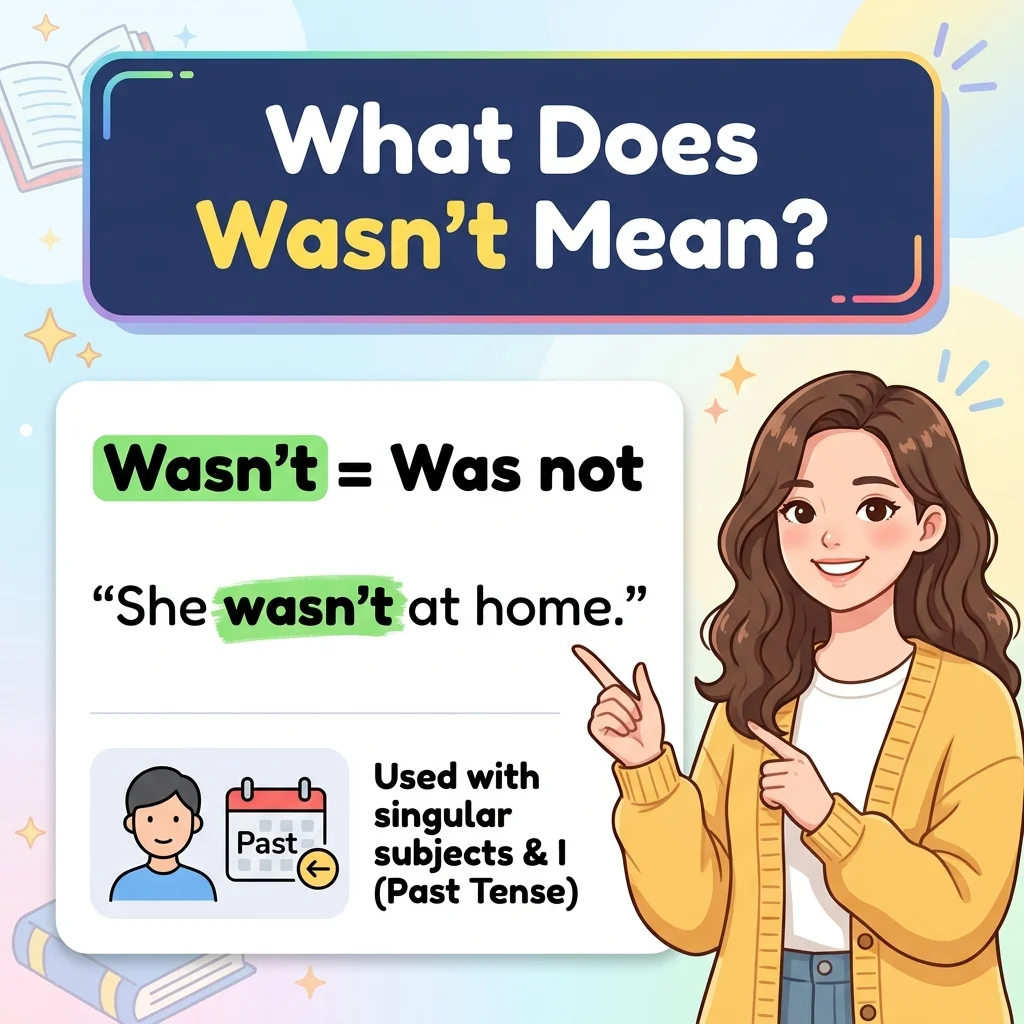
Wasn’t is the contraction of “was not.” It is the negative form of was, which is the past tense of the verb “to be.”
We generally use wasn’t with singular subjects and with the pronoun I when talking about ordinary past situations.
For example:
- I wasn’t at home yesterday.
- He wasn’t feeling well.
- She wasn’t ready.
- It wasn’t cold this morning.
- The movie wasn’t interesting.
- My brother wasn’t angry.
The full forms are:
- I was not at home.
- He was not feeling well.
- She was not ready.
- It was not cold.
In everyday conversation, wasn’t sounds more natural than was not in most situations.
Wasn’t Meaning in Simple English
In simple terms, wasn’t means that something was not true, present, happening, or in a particular condition in the past.
Consider this sentence:
“She wasn’t happy.”
It means that at a particular time in the past, she was not happy.
Similarly:
“The shop wasn’t open.”
This tells us that the shop was not open at that past time.
The meaning changes according to the main verb or adjective that follows it, but wasn’t always carries the basic idea of “was not.”
What Does Weren’t Mean?

Weren’t is the contraction of “were not.” It is the negative form of were, another past form of the verb “to be.”
We normally use weren’t with plural subjects and the pronoun you.
For example:
- We weren’t late.
- They weren’t ready.
- You weren’t listening.
- The children weren’t sleeping.
- My friends weren’t at school.
The full forms are:
- We were not late.
- They were not ready.
- You were not listening.
Weren’t Meaning in Simple English
Weren’t means “were not.” It normally describes a negative situation involving you, we, they, or another plural subject in the past.
For example:
“They weren’t at the party.”
This means they were not at the party.
Another example is:
“You weren’t wrong.”
This means the person being addressed was not wrong.
Weren’t can also appear with singular subjects in hypothetical or unreal situations. This special use is important because it creates one of the most common sources of confusion between wasn’t and weren’t.
Wasn’t vs Weren’t: The Main Difference
The simplest way to understand the difference is to look at the subject.
| Subject | Correct form | Example |
| I | wasn’t | I wasn’t hungry. |
| He | wasn’t | He wasn’t home. |
| She | wasn’t | She wasn’t ready. |
| It | wasn’t | It wasn’t easy. |
| You | weren’t | You weren’t late. |
| We | weren’t | We weren’t tired. |
| They | weren’t | They weren’t busy. |
| Plural noun | weren’t | The students weren’t ready. |
The basic rule is:
Wasn’t = was not
Weren’t = were not
In ordinary past-tense statements, use wasn’t with I, he, she, it, and singular nouns. Use weren’t with you, we, they, and plural nouns.
Quick Memory Trick
Think of it this way:
One person or thing → wasn’t
More than one person or thing → weren’t
There is one important exception:
You → weren’t, even when “you” refers to only one person.
For example:
- I wasn’t there.
- He wasn’t there.
- She wasn’t there.
- You weren’t there.
- We weren’t there.
- They weren’t there.
This pattern makes the basic rule much easier to remember.
When to Use Wasn’t
Use wasn’t when you need the negative past form of was.
It commonly appears with:
- I
- he
- she
- it
- singular nouns
Let’s look at each situation.
Wasn’t With “I”
Use wasn’t with I when describing a normal past situation.
Examples:
- I wasn’t tired last night.
- I wasn’t at work yesterday.
- I wasn’t ready for the test.
- I wasn’t feeling well.
- I wasn’t interested in the movie.
Here, “I” is the subject, so wasn’t is the standard choice.
Wasn’t With “He”
Use wasn’t with he.
Examples:
- He wasn’t at school.
- He wasn’t angry.
- He wasn’t available yesterday.
- He wasn’t listening.
- He wasn’t sure about the answer.
The sentence “He weren’t there” is incorrect in standard English because “he” takes was, not were, in an ordinary past-tense statement.
Wasn’t With “She”
Use wasn’t with she.
Examples:
- She wasn’t at home.
- She wasn’t happy.
- She wasn’t feeling well.
- She wasn’t interested.
- She wasn’t ready to leave.
A common mistake is saying “She weren’t ready.” The correct sentence is “She wasn’t ready.”
Wasn’t With “It”
Use wasn’t with it for ordinary past situations.
Examples:
- It wasn’t easy.
- It wasn’t raining.
- It wasn’t expensive.
- It wasn’t my fault.
- It wasn’t a good idea.
For example, if you are talking about yesterday’s weather, you can say:
“It wasn’t very cold yesterday.”
When to Use Weren’t
Use weren’t with:
- you
- we
- they
- plural nouns
Weren’t With “You”
One important point is that you always takes were in the past tense, whether you are talking to one person or several people.
Examples:
- You weren’t late.
- You weren’t listening.
- You weren’t at home.
- You weren’t ready.
- You weren’t wrong.
Even when speaking to one person, say:
“You weren’t there.”
Not:
“You wasn’t there.”
Weren’t With “We”
Use weren’t with we.
Examples:
- We weren’t tired.
- We weren’t at the office.
- We weren’t ready.
- We weren’t expecting you.
- We weren’t happy with the result.
Because “we” refers to more than one person, weren’t is the standard form.
Weren’t With “They”
Use weren’t with they.
Examples:
- They weren’t home.
- They weren’t interested.
- They weren’t listening.
- They weren’t prepared.
- They weren’t available yesterday.
The same rule applies to plural nouns.
Weren’t With Plural Nouns
Plural nouns normally take weren’t.
Examples:
- The students weren’t ready.
- My parents weren’t home.
- The cars weren’t clean.
- The books weren’t expensive.
- The children weren’t asleep.
Compare:
The child wasn’t asleep.
The children weren’t asleep.
The noun changes from singular to plural, so the verb changes from wasn’t to weren’t.
Wasn’t vs Weren’t in Questions
Both forms can be used to create negative questions, but the correct choice still depends on the subject.
With singular subjects:
- Wasn’t he at work?
- Wasn’t she your teacher?
- Wasn’t it raining?
- Wasn’t the meeting yesterday?
- Wasn’t I invited?
With plural subjects and “you”:
- Weren’t you tired?
- Weren’t they at home?
- Weren’t we supposed to leave?
- Weren’t the students ready?
- Weren’t your parents there?
Notice the subject-verb agreement.
Wasn’t + singular subject
Weren’t + you/we/they/plural subject
Examples in Everyday Conversation
Imagine your friend asks:
“Was Sarah at the party?”
You can answer:
“No, she wasn’t.”
If the question is:
“Were Sarah and Emma at the party?”
You answer:
“No, they weren’t.”
The same pattern works in many everyday conversations.
Wasn’t vs Weren’t With Adjectives
Both forms can be followed by adjectives.
Examples with wasn’t:
- I wasn’t hungry.
- He wasn’t happy.
- She wasn’t angry.
- It wasn’t difficult.
- The test wasn’t easy.
Examples with weren’t:
- We weren’t hungry.
- They weren’t happy.
- You weren’t angry.
- The questions weren’t difficult.
- The tests weren’t easy.
The adjective does not decide whether you use wasn’t or weren’t. The subject decides.
For example:
She wasn’t tired.
They weren’t tired.
The adjective “tired” stays the same. Only the subject and verb change.
Wasn’t vs Weren’t With Nouns
You can also use both forms before a noun or noun phrase.
Examples:
- I wasn’t a teacher.
- He wasn’t the manager.
- She wasn’t my friend.
- It wasn’t a mistake.
With plural subjects:
- We weren’t teachers.
- They weren’t managers.
- You weren’t the only students.
- These weren’t my books.
Again, check the subject before choosing the verb.
Wasn’t vs Weren’t With Locations
Both forms are frequently used when talking about where someone or something was.
Examples with wasn’t:
- I wasn’t at home.
- He wasn’t at school.
- She wasn’t in the office.
- The phone wasn’t on the table.
Examples with weren’t:
- We weren’t at home.
- They weren’t at school.
- You weren’t in the office.
- The phones weren’t on the table.
This is one of the easiest contexts in which to practice the difference.
Wasn’t vs Weren’t in Continuous Tenses
Both forms can be used with the past continuous tense.
The structure is:
Subject + wasn’t/weren’t + verb-ing
Examples:
- I wasn’t sleeping.
- He wasn’t working.
- She wasn’t studying.
- It wasn’t raining.
- You weren’t listening.
- We weren’t talking.
- They weren’t waiting.
Compare:
She wasn’t sleeping.
They weren’t sleeping.
The main verb remains in the -ing form. The auxiliary verb changes according to the subject.
More Past Continuous Examples
- I wasn’t watching television.
- He wasn’t paying attention.
- She wasn’t driving.
- You weren’t following the instructions.
- We weren’t arguing.
- They weren’t playing football.
Do not write:
“They wasn’t playing.”
Write:
“They weren’t playing.”
Wasn’t vs Weren’t in Passive Sentences
Both forms can also appear in passive constructions.
Examples with wasn’t:
- The door wasn’t locked.
- The letter wasn’t delivered.
- The problem wasn’t solved.
- The car wasn’t repaired.
Examples with weren’t:
- The doors weren’t locked.
- The letters weren’t delivered.
- The problems weren’t solved.
- The cars weren’t repaired.
The same subject rule applies.
Singular → wasn’t
Plural → weren’t
The Special Use of “Weren’t” With “I”
This is where English grammar becomes more interesting.
In ordinary past statements, we say:
“I wasn’t there.”
However, in hypothetical, unreal, or contrary-to-fact situations, weren’t can be used with I.
For example:
“If I weren’t so busy, I would help you.”
This sentence describes an imagined situation. The speaker is actually busy, but they are imagining what would happen if that were not true.
Another example:
“I wish I weren’t so tired.”
The speaker is tired in reality but wishes the situation were different.
This special grammatical form is often called the subjunctive or irrealis were.
Wasn’t vs Weren’t in Hypothetical Sentences
Compare these sentences:
“I wasn’t at home yesterday.”
This is a real past situation.
“If I weren’t at home, you could use my room.”
This describes a hypothetical situation.
The difference is not simply the subject. The meaning and sentence structure also matter.
Common Hypothetical Expressions With Weren’t
You may see weren’t after expressions such as:
- if
- wish
- as if
- as though
Examples:
- If I weren’t busy, I would come.
- I wish I weren’t so nervous.
- He acts as if he weren’t afraid.
- She talks as though she weren’t responsible.
This use can sound more formal or careful. In everyday speech, some speakers use was in certain hypothetical sentences, especially in informal American English. However, “were” remains the traditional standard form for many unreal or hypothetical constructions.
“If I Was” vs “If I Were”
The difference between “if I was” and “if I were” deserves special attention.
Use if I were when you are clearly describing an unreal, hypothetical, or imagined situation.
Example:
“If I were rich, I would travel around the world.”
The speaker is imagining being rich.
Another example:
“If I were you, I would talk to your teacher.”
This is a common expression used to give advice.
However, if I was can be correct when you are referring to a possible real past situation.
For example:
“If I was rude yesterday, I apologize.”
Here, the speaker is unsure whether they were rude. They are discussing a possible real event.
So:
- If I were you, I would apologize. → hypothetical
- If I was rude yesterday, I apologize. → possible real past event
This distinction helps explain why weren’t sometimes appears with I.
“I Wasn’t” vs “I Weren’t”
For ordinary past situations, the correct form is:
I wasn’t
Examples:
- I wasn’t hungry.
- I wasn’t there.
- I wasn’t ready.
- I wasn’t angry.
- I wasn’t sleeping.
Do not normally say:
“I weren’t hungry.”
However, I weren’t may appear in hypothetical or nonstandard contexts. In standard modern English, hypothetical sentences generally use I weren’t in situations where the subjunctive calls for were.
For example:
“I wish I weren’t so busy.”
This is grammatically different from:
“I wasn’t busy yesterday.”
The first expresses a wish about a current or imagined condition. The second reports a real past condition.
“He Wasn’t” vs “He Weren’t”
In ordinary English, use:
He wasn’t
Examples:
- He wasn’t there.
- He wasn’t ready.
- He wasn’t listening.
- He wasn’t happy.
The form “he weren’t” is not standard for an ordinary past statement.
However, were can occur with “he” in certain hypothetical constructions:
“He behaves as if he weren’t responsible.”
This is a more formal hypothetical use.
For everyday beginner-level English, remember:
He was → He wasn’t
They were → They weren’t
“She Wasn’t” vs “She Weren’t”
The normal form is:
She wasn’t
Examples:
- She wasn’t home.
- She wasn’t ready.
- She wasn’t angry.
- She wasn’t working.
In hypothetical constructions, weren’t may occur:
“I wish she weren’t so upset.”
This does not mean that “she weren’t” is generally correct. It is a special grammatical use.
“You Wasn’t” vs “You Weren’t”
This is a very common mistake.
The correct form is:
You weren’t
Not:
You wasn’t
Examples:
- You weren’t late.
- You weren’t listening.
- You weren’t at school.
- You weren’t ready.
- You weren’t wrong.
This rule applies whether you means one person or several people.
For example:
To one person: You weren’t at work.
To several people: You weren’t at work.
In both cases, weren’t is correct.
Wasn’t vs Weren’t: Common Mistakes
Learning these two forms becomes much easier when you know the mistakes to avoid.
Mistake 1: Using Wasn’t With “They”
Incorrect:
They wasn’t happy.
Correct:
They weren’t happy.
“They” takes were, so the negative form is weren’t.
Mistake 2: Using Weren’t With “He”
Incorrect:
He weren’t at home.
Correct:
He wasn’t at home.
“He” is singular, so ordinary past-tense English uses was.
Mistake 3: Using Wasn’t With “You”
Incorrect:
You wasn’t ready.
Correct:
You weren’t ready.
Remember that you always takes were in the past tense.
Mistake 4: Confusing Singular and Plural Nouns
Incorrect:
The student weren’t ready.
Correct:
The student wasn’t ready.
But:
The students weren’t ready.
The noun changes from singular to plural, so the verb changes too.
Mistake 5: Forgetting the Hypothetical Use of Weren’t
Some learners think weren’t can never follow “I” or another singular subject.
That is not completely true.
For example:
“I wish I weren’t so tired.”
This is standard in a hypothetical or wish construction.
Mistake 6: Writing “Was’nt”
The correct spelling is:
wasn’t
Not:
was’nt
The apostrophe replaces the missing letters in was not.
Mistake 7: Writing “Wern’t”
The correct spelling is:
weren’t
Not:
wern’t
The word comes from were not, and the apostrophe replaces the o in “not.”
Wasn’t and Weren’t Spelling Tips
Both words contain apostrophes because they are contractions.
was not → wasn’t
were not → weren’t
A simple spelling trick is to remember the original words first.
If the positive form is:
was
The negative contraction is:
wasn’t
If the positive form is:
were
The negative contraction is:
weren’t
Pronunciation Tip
In normal speech, wasn’t and weren’t are usually pronounced as single contracted forms.
Wasn’t sounds roughly like “wuz-unt.”
Weren’t sounds roughly like “wurnt.”
The exact pronunciation can vary depending on accent. You do not need to copy a particular accent to use them correctly.
Wasn’t vs Weren’t in British and American English
The basic subject rules are the same in both British and American English.
For ordinary past statements:
- I wasn’t
- He wasn’t
- She wasn’t
- It wasn’t
- You weren’t
- We weren’t
- They weren’t
The main variation appears in some hypothetical constructions, particularly sentences such as “If I were…” and “If I was…”
For careful formal writing, were is traditionally preferred for clearly unreal or hypothetical situations:
“If I were you, I would wait.”
In informal conversation, especially in some varieties of American English, was can also occur in certain hypothetical constructions.
For learners, a useful rule is to use were for clearly hypothetical expressions:
If I were you…
I wish I were…
If he were here…
This will help you produce standard formal English.
Wasn’t vs Weren’t With Real Past Events
When you are describing something that actually happened or did not happen, use the ordinary past-tense agreement.
Examples:
- I wasn’t at the meeting.
- She wasn’t at the meeting.
- He wasn’t at the meeting.
- We weren’t at the meeting.
- They weren’t at the meeting.
The rule is straightforward because these sentences describe real situations.
Example Conversation
A: Was Tom at the meeting?
B: No, he wasn’t.
A: Were his colleagues there?
B: No, they weren’t.
A: Were you there?
B: Yes, I was.
This short conversation shows how wasn’t and weren’t work naturally.
Wasn’t vs Weren’t With Time Expressions
You can use both forms with past time expressions such as:
- yesterday
- last night
- last week
- last year
- this morning
- two days ago
- when I was young
Examples:
- I wasn’t busy yesterday.
- She wasn’t at work last week.
- He wasn’t home last night.
- We weren’t ready this morning.
- They weren’t here two days ago.
The time expression does not determine the form. The subject does.
Wasn’t vs Weren’t With Questions and Short Answers
Short answers are an excellent way to practice these forms.
Question:
Was she tired?
Answer:
No, she wasn’t.
Question:
Were they tired?
Answer:
No, they weren’t.
Question:
Were you busy?
Answer:
No, I wasn’t.
Notice something interesting in the last example. The question uses were because the subject is “you,” but the answer uses wasn’t because the speaker says I.
More Short Answer Examples
Was he late?
No, he wasn’t.
Was it expensive?
No, it wasn’t.
Were we wrong?
No, we weren’t.
Were you tired?
No, I wasn’t.
Were they ready?
No, they weren’t.
Wasn’t vs Weren’t With There Was and There Were
Another useful area is the difference between there wasn’t and there weren’t.
Use there wasn’t with singular nouns or uncountable nouns.
Examples:
- There wasn’t a problem.
- There wasn’t enough food.
- There wasn’t any water.
- There wasn’t a car outside.
Use there weren’t with plural nouns.
Examples:
- There weren’t any problems.
- There weren’t enough chairs.
- There weren’t many people.
- There weren’t any cars outside.
Compare:
There wasn’t a student in the classroom.
There weren’t any students in the classroom.
This is another clear example of singular versus plural agreement.
Wasn’t vs Weren’t With Uncountable Nouns
Uncountable nouns usually take the singular form wasn’t.
Examples:
- The information wasn’t useful.
- The water wasn’t clean.
- The money wasn’t enough.
- The furniture wasn’t expensive.
- The advice wasn’t helpful.
Even though some of these things may contain many individual parts, English treats the nouns as uncountable, so wasn’t is normally used.
Wasn’t vs Weren’t Practice Examples
Here are more examples to help you recognize the pattern.
Examples With Wasn’t
- I wasn’t prepared.
- He wasn’t honest about the situation.
- She wasn’t at the restaurant.
- It wasn’t a difficult question.
- The dog wasn’t hungry.
- My phone wasn’t charged.
- The movie wasn’t very long.
- The weather wasn’t good.
- The answer wasn’t correct.
- My brother wasn’t available.
Examples With Weren’t
- You weren’t prepared.
- We weren’t prepared.
- They weren’t prepared.
- The students weren’t ready.
- My friends weren’t available.
- The dogs weren’t hungry.
- The phones weren’t charged.
- The movies weren’t very long.
- The answers weren’t correct.
- The workers weren’t at the office.
Wasn’t vs Weren’t: Side-by-Side Examples
| Wasn’t | Weren’t |
| I wasn’t tired. | We weren’t tired. |
| He wasn’t ready. | They weren’t ready. |
| She wasn’t home. | You weren’t home. |
| It wasn’t easy. | The questions weren’t easy. |
| The child wasn’t asleep. | The children weren’t asleep. |
| The car wasn’t clean. | The cars weren’t clean. |
| My friend wasn’t there. | My friends weren’t there. |
| The student wasn’t late. | The students weren’t late. |
This table shows the main pattern clearly.
A Simple Formula to Remember
You can memorize these two formulas:
I/He/She/It + wasn’t + complement
Examples:
- I wasn’t ready.
- He wasn’t ready.
- She wasn’t ready.
- It wasn’t ready.
You/We/They + weren’t + complement
Examples:
- You weren’t ready.
- We weren’t ready.
- They weren’t ready.
For nouns:
Singular noun + wasn’t
Plural noun + weren’t
Examples:
- The boy wasn’t ready.
- The boys weren’t ready.
How to Choose Between Wasn’t and Weren’t Quickly
When you are writing or speaking, follow these steps.
Step 1: Find the Subject
Look at who or what the sentence is about.
For example:
The girl ___ happy.
The subject is “girl.”
Step 2: Decide Whether the Subject Is Singular or Plural
“Girl” is singular.
Therefore:
The girl wasn’t happy.
Now consider:
The girls ___ happy.
“Girls” is plural.
Therefore:
The girls weren’t happy.
Step 3: Remember the “You” Rule
Whenever the subject is you, use weren’t in ordinary past-tense negatives.
You weren’t late.
Step 4: Check Whether the Sentence Is Hypothetical
If the sentence describes an unreal or imagined situation, weren’t may be correct with a singular subject.
For example:
If I weren’t busy, I would help.
This is different from:
I wasn’t busy yesterday.
Wasn’t vs Weren’t: Mini Quiz
Try filling in each blank with wasn’t or weren’t.
- I ___ at school yesterday.
- They ___ ready.
- She ___ feeling well.
- You ___ late.
- We ___ at home.
- He ___ interested.
- The children ___ quiet.
- The child ___ quiet.
- It ___ expensive.
- My parents ___ angry.
Answers
- wasn’t
- weren’t
- wasn’t
- weren’t
- weren’t
- wasn’t
- weren’t
- wasn’t
- wasn’t
- weren’t
The answers follow the basic subject agreement rule.
Common Questions About Wasn’t vs Weren’t
Is “wasn’t” the same as “was not”?
Yes. Wasn’t is the contracted form of was not.
For example:
She wasn’t happy.
means:
She was not happy.
The meaning is the same. The contraction is usually more common in everyday speech and informal writing.
Is “weren’t” the same as “were not”?
Yes. Weren’t is the contraction of were not.
For example:
They weren’t ready.
means:
They were not ready.
Is it “I wasn’t” or “I weren’t”?
For ordinary past statements, use I wasn’t.
Example:
I wasn’t at home yesterday.
However, weren’t can be used with “I” in hypothetical or unreal constructions:
I wish I weren’t so tired.
Is it “you wasn’t” or “you weren’t”?
The standard form is you weren’t.
Example:
You weren’t listening.
“You” takes were, even when it refers to one person.
Is it “he wasn’t” or “he weren’t”?
For ordinary past statements, use he wasn’t.
Example:
He wasn’t at school.
Is it “she wasn’t” or “she weren’t”?
For ordinary past statements, use she wasn’t.
Example:
She wasn’t ready.
Is it “they wasn’t” or “they weren’t”?
Use they weren’t.
Example:
They weren’t at the office.
“They” takes were.
Can I use “weren’t” with “I”?
Yes, but the context matters.
Use I wasn’t for ordinary past facts:
I wasn’t there yesterday.
Use I weren’t in certain hypothetical or unreal constructions:
I wish I weren’t so busy.
Is “If I wasn’t” grammatically correct?
It can be correct when you are talking about a possible real past situation.
For example:
“If I wasn’t clear earlier, let me explain again.”
When the situation is clearly hypothetical or contrary to fact, traditional standard grammar generally prefers were:
“If I weren’t so busy, I would help you.”
Which is correct: “If I wasn’t you” or “If I weren’t you”?
The standard expression is:
“If I were you…”
For example:
“If I were you, I would wait.”
This is a hypothetical expression used when giving advice.
Which is correct: “They wasn’t” or “They weren’t”?
They weren’t is correct in standard English.
Example:
They weren’t ready for the meeting.
Which is correct: “We wasn’t” or “We weren’t”?
We weren’t is correct.
Example:
We weren’t at home last night.
Which is correct: “There wasn’t” or “There weren’t”?
Both can be correct, depending on the noun that follows.
Use there wasn’t with a singular or uncountable noun:
There wasn’t a problem.
Use there weren’t with a plural noun:
There weren’t any problems.
Can “wasn’t” and “weren’t” be used in the same sentence?
Yes.
For example:
I wasn’t ready, and they weren’t ready either.
Here, wasn’t agrees with “I,” while weren’t agrees with “they.”
Another example:
The manager wasn’t there, but the employees weren’t there either.
Wasn’t vs Weren’t: Final Comparison
The difference becomes simple when you focus on the subject.
Wasn’t is the contraction of was not. It normally goes with I, he, she, it, and singular nouns.
Weren’t is the contraction of were not. It normally goes with you, we, they, and plural nouns.
The most important examples to remember are:
- I wasn’t
- He wasn’t
- She wasn’t
- It wasn’t
- You weren’t
- We weren’t
- They weren’t
- The boy wasn’t
- The boys weren’t
There is also a special use of weren’t in hypothetical or unreal sentences:
- If I weren’t busy, I would come.
- I wish I weren’t so tired.
- If he weren’t here, we would leave.
This is why you should not treat the rule as simply “weren’t is always plural.” In ordinary past statements, that shortcut works well. In hypothetical grammar, however, were can appear with singular subjects.
Final Conclusion
The difference between wasn’t vs weren’t mainly comes down to subject-verb agreement. Wasn’t means “was not” and normally works with I, he, she, it, and singular nouns. Weren’t means “were not” and normally works with you, we, they, and plural nouns.
The most important exception involves hypothetical or unreal situations. In these cases, weren’t can appear with singular subjects, as in “If I weren’t busy” and “I wish she weren’t here.” Understanding this special use will help you avoid confusion when you encounter it in books, conversations, or formal writing.

Michael Collins is a skilled writer who creates clear, practical, and reader-friendly content. He focuses on language, grammar, word meanings, and everyday expressions, making complex topics simple to understand.