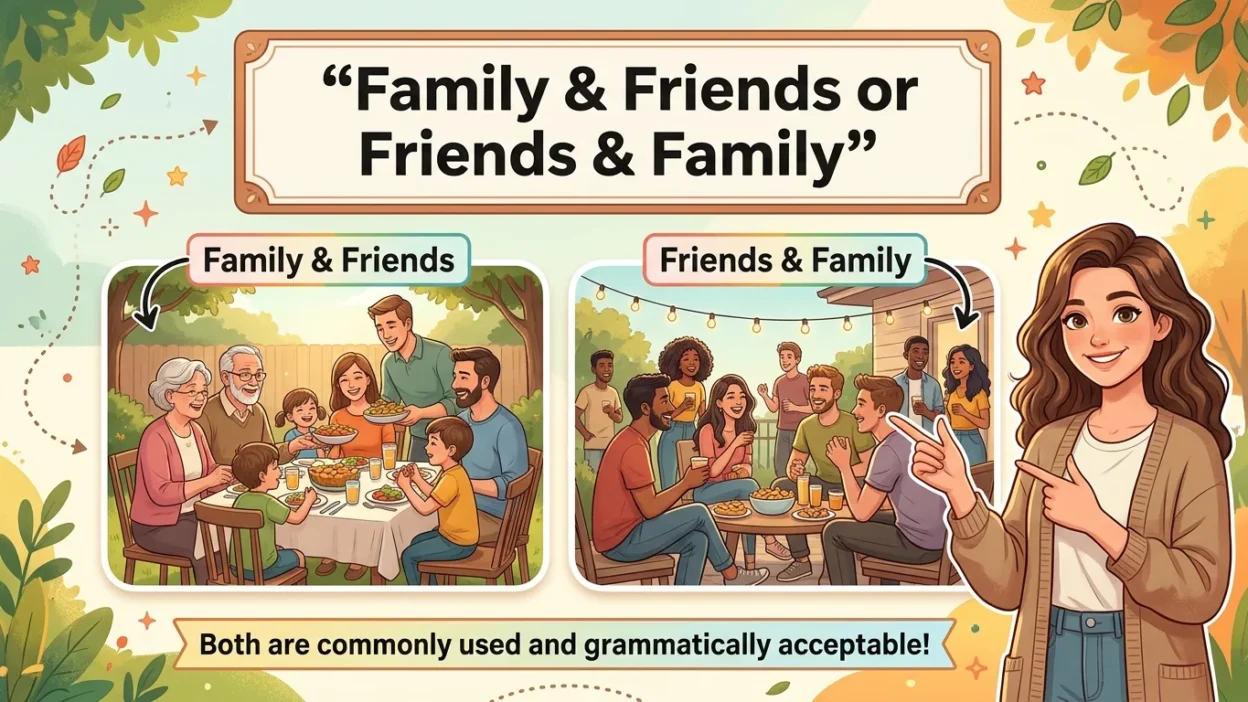
Have you ever wondered whether to write Family & Friends or Friends & Family? Both phrases are grammatically correct and commonly used in invitations, social media posts, event announcements, and everyday conversations. The main difference isn’t grammar but word order and emphasis. Family & Friends places family first, highlighting relatives before friends.
Friends & Family puts friends first and is a widely recognized expression for referring to the people closest to you. Neither phrase is universally more correct, so your choice depends on personal preference, context, and the message you want to convey.
Understanding Family & Friends vs Friends & Family can help you choose the phrase that sounds most natural for birthday invitations, holiday greetings, celebrations, business messages, and personal announcements. This guide explains both expressions, compares their usage, and provides practical examples to help you decide which wording works best.
Quick Answer:
Both “Family & Friends” and “Friends & Family” are correct English phrases.
They have essentially the same basic meaning: people who are your relatives and people who have a close personal relationship with you.
The difference is mainly the order in which the groups are mentioned.
| Phrase | Meaning | Grammar | Common Use |
| Family & Friends | Family members and friends | Correct | Invitations, events, announcements |
| Friends & Family | Friends and family members | Correct | Casual writing, messages, promotions |
| Family and Friends | Same meaning | Correct | Formal writing |
| Friends and Family | Same meaning | Correct | Formal and casual writing |
For example:
- Family & friends are welcome.
- Friends & family are welcome.
Both sentences can communicate the same idea.
The best choice depends on context and emphasis, rather than grammatical correctness.
What Does “Family & Friends” Mean?
“Family & Friends” means your relatives and the people you consider friends.
The word family usually refers to people connected to you through blood, marriage, adoption, or close family relationships. The word friends refers to people with whom you have a personal relationship based on affection, trust, or shared interests.
The ampersand (&) simply replaces the word and.
Therefore:
Family & Friends = Family and Friends
For example:
We are inviting family & friends to celebrate our anniversary.
Here, the phrase means that both relatives and friends are invited.
When Is “Family & Friends” Used?
“Family & Friends” is especially common in:
- Event invitations
- Wedding announcements
- Birthday invitations
- Social media posts
- Restaurant promotions
- Community announcements
- Fundraising events
- Holiday messages
- Informal advertisements
- Personal greetings
For example:
We would love to see all our family & friends at the party.
The phrase sounds warm and welcoming.
Examples of “Family & Friends”
Here are some natural examples:
- Family & friends are invited to our wedding.
- Thank you to all my family & friends for your support.
- We are having dinner with family & friends tonight.
- The event is open to family & friends.
- I enjoyed spending the holiday with family & friends.
- Our family & friends made the celebration special.
- We shared the good news with family & friends.
- Family & friends gathered to celebrate her birthday.
In all these examples, the meaning is easy to understand.
What Does “Friends & Family” Mean?
“Friends & Family” means friends and relatives.
It has the same basic meaning as “Family & Friends.” The only major difference is that friends comes first.
For example:
We invited friends & family to our new home.
This means that both friends and family members were invited.
Putting “friends” first can sometimes give friends slightly more attention because they appear first in the phrase. However, this is usually a very small stylistic difference.
When Is “Friends & Family” Used?
You may see “Friends & Family” in:
- Social media captions
- Personal messages
- Company promotions
- Shopping events
- Invitations
- Holiday greetings
- Newsletters
- Community announcements
- Informal emails
- Marketing campaigns
For example:
Our friends & family have always supported us.
This sounds natural in casual English.
Examples of “Friends & Family”
Consider these sentences:
- Friends & family are welcome to attend.
- We celebrated the holiday with friends & family.
- Thank you to our friends & family for being there.
- We shared the announcement with friends & family.
- Friends & family helped us during the move.
- The party was attended by friends & family.
- We want to thank our friends & family for their support.
- Spending time with friends & family makes the holidays special.
Again, these sentences are grammatically acceptable.
Family & Friends vs Friends & Family
The most important point is simple: there is no major grammatical difference between the two phrases.
Both use two plural nouns connected by and or &.
The difference is their order:
Family & Friends
versus
Friends & Family
The first puts family first.
The second puts friends first.
Neither is automatically more correct.
| Feature | Family & Friends | Friends & Family |
| Grammar | Correct | Correct |
| Meaning | Family and friends | Friends and family |
| First word | Family | Friends |
| Informal use | Very common | Very common |
| Formal use | Use “and” | Use “and” |
| Ampersand | Suitable for casual/design contexts | Suitable for casual/design contexts |
| Main difference | Word order | Word order |
If you are simply talking about both groups, you can choose either version.
Does Word Order Change the Meaning?
Usually, no.
“Family & Friends” and “Friends & Family” generally communicate the same idea.
However, English speakers sometimes put the group they want to mention first for a reason. This does not necessarily create a different dictionary meaning, but it can create a slight difference in emphasis.
For example:
I invited family & friends.
This puts family first.
Compare it with:
I invited friends & family.
This puts friends first.
The overall message remains the same.
The difference becomes more noticeable when the writer wants to focus on one particular group.
For example:
I want to thank my family & friends for supporting me.
The speaker may naturally think about family first.
On the other hand:
I want to thank my friends & family for supporting me.
The speaker may be thinking about friends first.
Neither sentence is grammatically superior.
Is “Family & Friends” Grammatically Correct?
Yes.
“Family & Friends” is grammatically correct, especially when used as a heading, title, invitation phrase, caption, or informal expression.
The more traditional form in ordinary sentences is “family and friends.”
For example:
We invited family and friends to dinner.
This is completely standard.
You could also write:
We invited family & friends to dinner.
This is understandable and commonly seen, particularly in informal communication.
However, the ampersand has a more visual, compact, and informal feel.
Is “Friends & Family” Grammatically Correct?
Yes.
“Friends & Family” is also grammatically correct.
The same rule applies here. In formal prose, “friends and family” is generally the safer choice.
For example:
We appreciate the support of our friends and family.
For a poster or event title, you might write:
Friends & Family Celebration
The ampersand works well because the phrase is being used as a title.
“And” vs “&”: Which Should You Use?
One of the most common questions is whether you should write and or &.
Both can connect words, but they are not always interchangeable in every writing situation.
Use “and” in Formal Writing
In formal writing, and is usually the better choice.
For example:
We would like to invite family and friends to the ceremony.
This sounds polished and appropriate.
You should generally prefer and in:
- Academic writing
- Formal reports
- Professional documents
- Formal letters
- Essays
- Official announcements
- Business correspondence
Use “&” in Informal or Visual Writing
The ampersand is often suitable when space, design, or a casual tone matters.
For example:
Family & Friends Night
This works well as an event title.
You might also see:
Friends & Family Sale
or:
Family & Friends Weekend
The ampersand makes the phrase shorter and visually noticeable.
Examples
Formal:
We invite all family and friends to attend the ceremony.
Informal:
Family & Friends Night is this Saturday!
Both are understandable. The style is different.
Why Do People Say “Family and Friends”?
“Family and friends” is a very established English expression. It is often used when people want to refer broadly to the people closest to someone.
For example:
Her family and friends supported her during the celebration.
The expression can also appear in speeches, announcements, sympathy messages, and public statements.
You may hear:
“Dear family and friends…”
This is especially common when addressing a group at an event.
For formal writing, family and friends is often the safest option because it follows standard prose conventions.
Why Do People Say “Friends and Family”?
“Friends and family” is equally natural.
It is particularly common in everyday speech and informal communication.
For example:
I spent the weekend with friends and family.
The phrase flows naturally because both nouns are plural and connected by and.
There is no grammar rule saying that “family” must come before “friends.”
That is an important point to remember.
Family & Friends or Friends & Family for Invitations
If you are creating an invitation, either phrase can work.
For example:
Family & Friends, You Are Invited!
Or:
Friends & Family, Join Us for Dinner!
Both are acceptable.
However, if the invitation is formal, consider using and instead of &:
Family and Friends, You Are Invited to Celebrate With Us
The exact choice depends on the tone of your event.
For a Formal Wedding Invitation
A formal invitation might use:
We warmly invite our family and friends to celebrate with us.
This sounds traditional and polished.
For a Birthday Party
A casual invitation might say:
Family & Friends Birthday Celebration
The ampersand fits the relaxed style.
For a Community Event
You could write:
Friends and Family Day
or:
Friends & Family Day
Both can work depending on the design and tone.
Family & Friends or Friends & Family in a Sentence
Both versions can appear naturally in a sentence.
Family & Friends
I spent the evening with family and friends.
We invited family and friends to our home.
My family and friends supported me.
Friends & Family
I spent the evening with friends and family.
We invited friends and family to our home.
My friends and family supported me.
Notice that the meaning remains almost identical.
The choice is mainly stylistic.
Is “Family & Friends” More Correct Than “Friends & Family”?
No.
There is no general grammar rule that makes “Family & Friends” more correct.
Likewise, “Friends & Family” is not grammatically wrong.
If someone tells you that one phrase is always correct and the other is always incorrect, that claim is too strong.
English allows both word orders.
The choice may depend on:
- Context
- Personal preference
- Emphasis
- Common phrasing
- Visual design
- Formality
- Sentence rhythm
Is “Friends & Family” More Natural?
It can sound very natural, just as “Family & Friends” can.
Different speakers and contexts may favor different orders.
For example:
We spent Christmas with friends and family.
sounds completely natural.
So does:
We spent Christmas with family and friends.
You do not need to worry about choosing the “correct” order in ordinary conversation.
Choose the version that fits your sentence and intended emphasis.
Common Mistakes With Family & Friends
Although the two phrases are simple, writers sometimes make mistakes when using them.
Mistake 1: Thinking One Order Is Grammatically Wrong
Some people believe that “Friends & Family” is incorrect because they have learned “Family & Friends.”
That is not true.
Both word orders are acceptable.
Incorrect assumption:
Friends & Family is always wrong.
Better understanding:
Friends & Family and Family & Friends are both correct.
Mistake 2: Using “Family’s and Friends”
This is usually incorrect when you simply mean two groups.
For example:
Family’s and friends are invited.
The apostrophe does not belong there.
The correct version is:
Family and friends are invited.
Or:
Family & friends are invited.
Mistake 3: Writing “Families & Friend”
If you are referring to multiple families and multiple friends, the nouns should match the intended number.
For example:
Families and friends attended the event.
Here, both nouns are plural.
However, if you mean one person’s family and their friends, use:
Family and friends attended the event.
Mistake 4: Using an Ampersand in Every Situation
The ampersand is not always the best choice.
In an academic essay, this:
Family & friends can influence our decisions.
is less conventional than:
Family and friends can influence our decisions.
The word and is usually better for formal prose.
Mistake 5: Confusing “Family” With “Families”
“Family” can be used as a collective noun.
For example:
My family is visiting tomorrow.
Here, “family” refers to one family group.
If you mean multiple family groups, use:
Families are visiting tomorrow.
This distinction matters when you build longer sentences.
Family and Friends: Singular or Plural Verb?
Another useful grammar point concerns the verb.
When family and friends are joined by and, the subject is plural.
Therefore, use a plural verb.
Correct:
Family and friends are welcome.
Incorrect:
Family and friends is welcome.
Why?
Because family and friends together form a compound subject.
The same rule applies to:
Friends and family are welcome.
The word order does not change the plural grammar.
More Examples
Correct:
Family and friends are coming tonight.
Correct:
Friends and family are invited.
Correct:
Family and friends have supported us.
Correct:
Friends and family were present.
The plural verb agrees with the combined subject.
Is “Family & Friends” a Title?
Yes.
You can use Family & Friends as a title or heading.
For example:
Family & Friends
This could be the name of:
- A social event
- A newsletter
- A photo album
- A Facebook group
- A celebration
- A dinner
- A community program
When used as a title, capitalization is a matter of style.
You might write:
Family & Friends
or:
Family and Friends
Both are possible.
Is “Friends & Family” a Good Event Name?
Yes.
Friends & Family works well as an event name because it is short, familiar, and easy to understand.
For example:
Friends & Family Dinner
Friends & Family Celebration
The phrase immediately tells readers who the event is intended for.
Family & Friends vs Friends & Family in Business
Businesses sometimes use these phrases for special promotions.
For example:
Friends & Family Sale
This is a familiar promotional expression. It can refer to a special discount or event aimed at a company’s customers, employees, or their personal connections.
You might also see:
Family & Friends Discount
The meaning is clear in both cases.
In business writing, follow the company’s established branding if one exists.
If you are creating a new promotion, choose whichever order sounds better with the rest of the title.
Which One Should You Use in Formal Writing?
For formal writing, focus less on whether family or friends comes first and more on using and instead of &.
For example:
We would like to thank our family and friends for their support.
This is more suitable for a formal letter than:
We would like to thank our family & friends for their support.
The second version is not necessarily ungrammatical. It simply feels more informal or design-oriented.
Formal Examples
We are grateful to our family and friends for attending the ceremony.
The support of our friends and family has meant a great deal to us.
We would like to welcome our family and friends to the celebration.
All three are appropriate in formal contexts.
Which One Should You Use on Social Media?
Social media gives you much more freedom.
You can write:
Family & Friends ❤️
or:
Friends & Family ❤️
Both are natural.
The ampersand can also make a caption shorter.
For example:
Good food, great memories, family & friends. ❤️
Or:
Weekend well spent with friends & family. ❤️
These are casual and easy to read.
Family & Friends or Friends & Family in British and American English
Both phrases are understood in British English and American English.
There is no major difference in meaning between the two varieties of English here.
You can write:
family and friends
or:
friends and family
in both British and American English.
The same applies to:
Family & Friends
and:
Friends & Family
The larger style difference concerns the use of & rather than and, particularly in formal writing.
Family & Friends vs Friends & Family: Which Sounds Better?
There is no universal answer.
What sounds better often depends on the sentence.
For example:
I want to spend more time with family and friends.
This sounds very natural.
But this also sounds natural:
I want to spend more time with friends and family.
The best choice may simply be the one that fits your rhythm.
If you are naming an event, branding can also influence your decision.
For example:
Family & Friends Day
has a slightly different rhythm from:
Friends & Family Day
Both are clear.
How to Remember the Difference
A simple way to remember the rule is:
Family & Friends = Family + Friends
Friends & Family = Friends + Family
The order changes, but the basic meaning does not.
Think of it like changing the order of two items in a shopping list.
If you write:
Apples and oranges
and then:
Oranges and apples
you are still talking about the same two fruits.
The same general idea applies here.
More Examples for Everyday English
Here are additional examples to help you see how both phrases work.
With “Family and Friends”
My family and friends know about the event.
We enjoyed dinner with family and friends.
Family and friends gathered at the house.
She shared the news with her family and friends.
His family and friends were happy for him.
I appreciate everything my family and friends have done.
With “Friends and Family”
My friends and family know about the event.
We enjoyed dinner with friends and family.
Friends and family gathered at the house.
She shared the news with her friends and family.
His friends and family were happy for him.
I appreciate everything my friends and family have done.
The grammatical structure remains the same.
Only the order changes.
When Should You Use “Family & Friends”?
Use Family & Friends when:
- You want to mention family first.
- You are creating an informal event title.
- You are writing a social media caption.
- You are designing a poster.
- You want a short visual phrase.
- You naturally think of family before friends.
Example:
Family & Friends Picnic — Saturday at 5 PM
When Should You Use “Friends & Family”?
Use Friends & Family when:
- You want to mention friends first.
- You are creating a casual title.
- You are writing an invitation.
- You are making a promotional phrase.
- The phrase sounds better in your particular sentence.
Example:
Friends & Family Dinner — Join Us This Weekend
Again, neither choice is grammatically superior.
When Should You Avoid the Ampersand?
Avoid using & when your writing needs a formal or academic tone.
For example, in a school essay, write:
Family and friends can influence a person’s development.
rather than:
Family & friends can influence a person’s development.
Similarly, in a formal report:
The event was attended by family and friends.
is usually preferable.
The ampersand is best treated as a style and space-saving symbol, not as a mandatory replacement for “and.”
Family & Friends or Friends & Family: Common Questions
Is “Family & Friends” correct?
Yes. Family & Friends is grammatically acceptable and commonly used in informal writing, titles, invitations, captions, and event names.
Is “Friends & Family” correct?
Yes. Friends & Family is also correct. It has essentially the same meaning as Family & Friends, but “friends” comes first.
Which is more correct, Family & Friends or Friends & Family?
Neither is inherently more correct. Both phrases are grammatically acceptable. Choose based on context, emphasis, and style.
Should I write “Family and Friends” instead of “Family & Friends”?
In formal writing, Family and Friends is generally the better stylistic choice. The ampersand is more common in informal, visual, or branding contexts.
Can I use “Friends & Family” in a formal email?
You can, but friends and family usually looks more polished in formal prose.
For example:
We would like to thank our friends and family for attending.
Is “Family & Friends” singular or plural?
The phrase refers to two groups, so when they form the subject together, use a plural verb.
For example:
Family and friends are welcome.
Is “Family & Friends” an English phrase?
Yes. It is a common English expression referring to relatives and friends.
Does “Friends & Family” have a different meaning?
Usually, no. It means essentially the same thing as Family & Friends. The primary difference is word order.
Which phrase is better for an invitation?
Both work. For a formal invitation, family and friends or friends and family is usually more conventional. For a casual invitation or designed heading, Family & Friends or Friends & Family works well.
Can I say “Family and Friend”?
Usually, no, if you mean multiple friends. The natural phrase is family and friends.
For example:
We invited family and friends.
If you mean one specific friend, you can say:
We invited our family and one friend.
Can “family” be plural?
Yes, when you mean more than one family, use families.
For example:
Several families attended the event.
But when you mean one family group, family is normally used.
Is “Family’s & Friends” correct?
No, not when you simply mean “family and friends.” The apostrophe in family’s indicates possession or a contraction, so it should not be added simply to make the phrase plural.
Use:
Family & Friends
or:
Family and Friends
Final Thoughts
The choice between Family & Friends and Friends & Family is much simpler than it may first appear. Both phrases are correct, and both generally mean the same thing. The main difference is the order of the nouns.
Family & Friends places family first, while Friends & Family places friends first. This may create a small difference in emphasis, but it usually does not change the overall meaning.

Emily Parker is a dedicated writer who enjoys creating clear, useful, and easy-to-understand content. She focuses on language, grammar, word meanings, and everyday expressions to help readers find simple and reliable answers.