
Have you ever been unsure whether to say “disoriented” or “disorientated”? Both forms can look correct, and both are used by English speakers. The difference mainly comes down to regional usage and style, rather than a completely different meaning.
If you are learning English, this can be confusing because one version is much more common in American English, while the other appears more frequently in British English. However, you may encounter either word in different varieties of English.
In this guide, we will explain disoriented vs disorientated, including their meanings, pronunciation, grammar, spelling, usage, examples, and the situations where each form sounds natural. We will also look at whether one is technically wrong and answer common questions people ask about these two words.
Quick Answer :
Disoriented and disorientated generally have the same meaning. Both describe a person who feels confused, lost, or unable to understand where they are or what is happening.
The main difference is regional preference:
- Disoriented is especially common in American English.
- Disorientated is especially common in British English.
- Both forms are grammatically acceptable.
- Neither word automatically has a different meaning from the other.
- Choose the form that matches the variety of English you are writing in.
For example:
I felt disoriented when I woke up.
Or:
I felt disorientated when I woke up.
Both sentences communicate essentially the same idea.
If you are writing for a general international audience, disoriented is often the simpler choice. If your writing follows British English conventions, disorientated is also perfectly natural.
What Does Disoriented Mean?
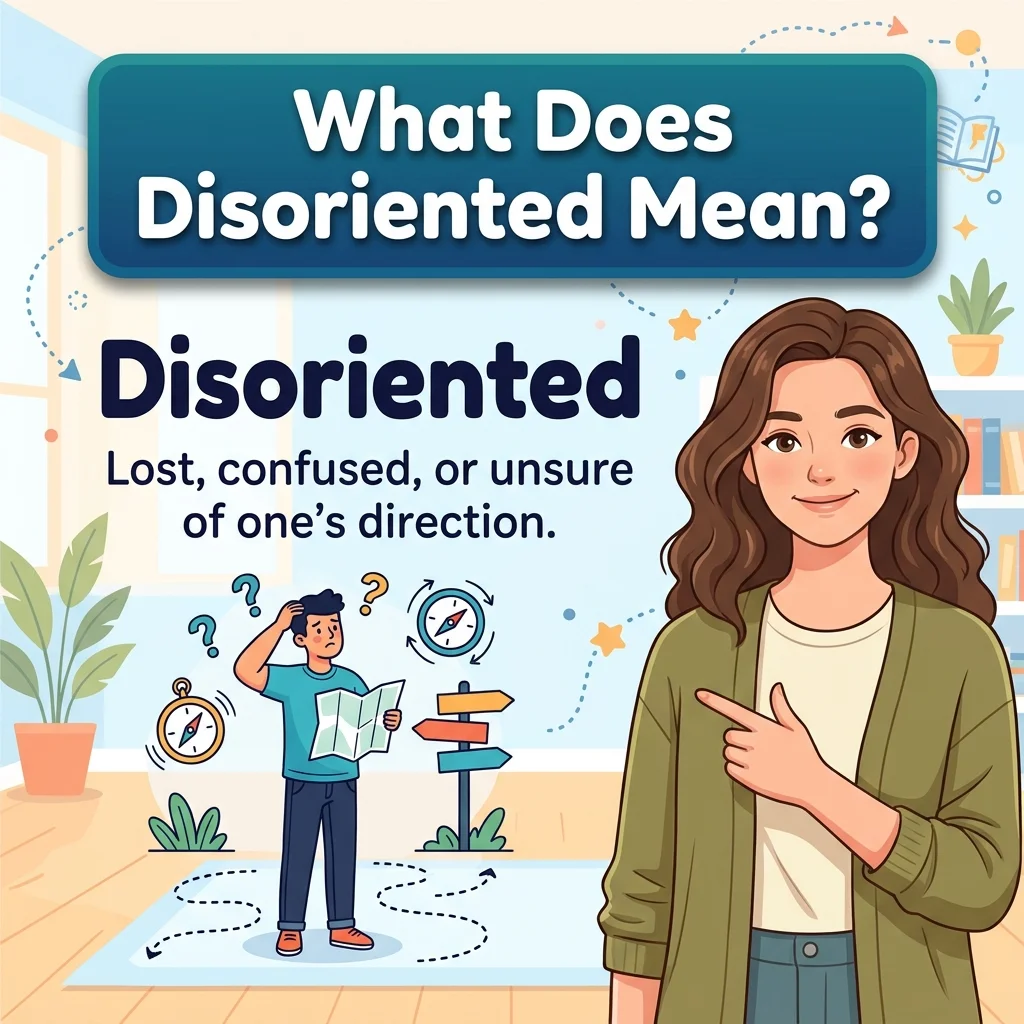
Disoriented is the past participle and past-tense form of disorient. It describes someone who has become confused about their surroundings, situation, direction, or circumstances.
In simple English, if you are disoriented, you do not know exactly where you are, what is happening, or which direction you should take.
For example:
After waking from a long sleep, I felt disoriented.
The person may need a few moments to understand their surroundings.
The word can describe both physical confusion and mental or situational confusion.
Physical Meaning of Disoriented
The physical sense usually involves losing your sense of direction or location.
For example:
I became disoriented after walking through the unfamiliar streets.
Here, the person does not know exactly where they are or which way they should go.
Other examples include:
- The hiker became disoriented in the forest.
- I felt disoriented after getting off the train.
- The bright lights left me disoriented.
- She became disoriented in the unfamiliar building.
- He looked disoriented after waking up.
Mental or Situational Meaning of Disoriented
Disoriented can also describe confusion caused by a situation, experience, or sudden change.
For example:
Moving to a completely new city left him disoriented.
The person may know where they physically are but still feel uncertain about how to deal with the new environment.
You might also say:
The sudden change in plans left me feeling disoriented.
Here, the word describes confusion rather than simply being lost.
What Does Disorientated Mean?
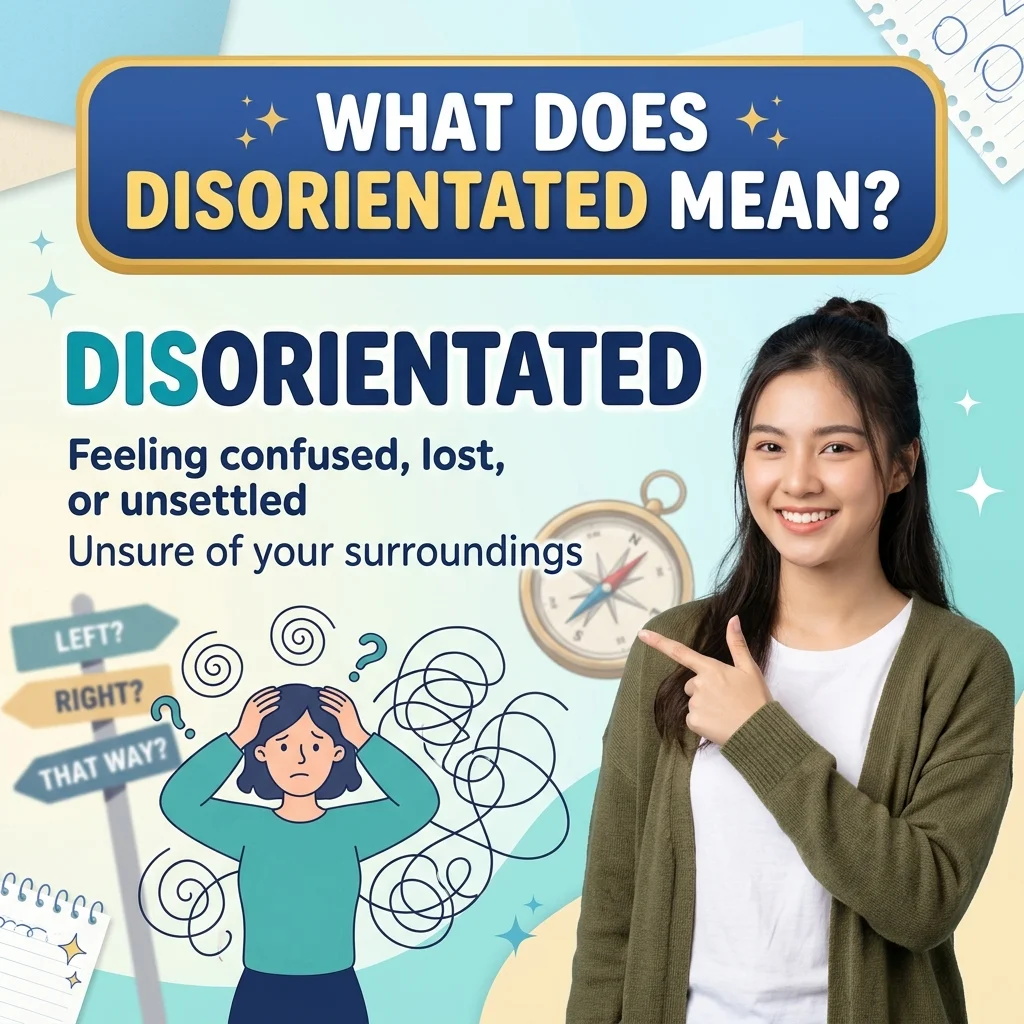
Disorientated has essentially the same meaning as disoriented. It describes someone who is confused, uncertain, or unable to determine their position, direction, or situation.
For example:
She felt disorientated after entering the unfamiliar building.
This means she felt confused about where she was or how to find her way around.
The word is particularly familiar in British English, although usage can vary between speakers and regions.
Examples of Disorientated
Here are some natural examples:
- I felt disorientated after the long flight.
- The patient appeared disorientated when he woke up.
- She became disorientated in the crowded station.
- The sudden noise left him disorientated.
- We were completely disorientated after losing the map.
These sentences work in the same basic way as their versions using disoriented.
Disoriented vs Disorientated: Main Difference
The biggest difference is regional usage, not meaning.
| Feature | Disoriented | Disorientated |
| Basic meaning | Confused or lost | Confused or lost |
| Grammar | Adjective/past participle | Adjective/past participle |
| American English | Very common | Less common |
| British English | Common | Very common |
| Canadian English | Used | Also used |
| Meaning | Essentially the same | Essentially the same |
| Correct spelling | Yes | Yes |
So, if someone asks, “Is it disoriented or disorientated?”, the answer is that both are correct.
The choice often depends on the variety of English you use.
Is Disoriented or Disorientated More Common?
The answer depends on the English variety.
Disoriented is strongly associated with American English and is widely recognised internationally. Disorientated is particularly common in British English.
This difference is similar to several other English variations where different forms are accepted in different regions.
For example, British and American English sometimes prefer different endings or spellings without changing the basic meaning of a word.
That means you should not automatically mark disorientated as incorrect simply because you normally use disoriented.
Likewise, British English speakers do not need to treat disoriented as an incorrect form.
Is Disorientated Correct English?
Yes. Disorientated is correct English.
It is a recognised form of the verb disorient and is widely used, particularly in British English.
For example:
The tourist became disorientated after taking the wrong turn.
There is nothing grammatically wrong with this sentence.
If you normally write in American English, however, disoriented will generally sound more natural.
Is Disoriented Correct English?
Yes. Disoriented is also correct English.
It is extremely common in American English and is also understood and used in other varieties of English.
For example:
I was completely disoriented when I woke up in the middle of the night.
This sentence is grammatically correct.
Therefore, the question is not really about right vs wrong. It is mostly about which form fits your preferred variety of English.
Disorient vs Disorientate
To understand these words better, it helps to look at the base verbs.
Disorient
Disorient means to cause someone to lose their sense of direction or become confused.
For example:
The unfamiliar surroundings disoriented me.
The verb is common in American English and is also used in British English.
Disorientate
Disorientate means essentially the same thing.
For example:
The unfamiliar surroundings disorientated me.
Again, the meaning remains basically unchanged.
The difference is mainly the additional -ate ending in disorientate.
Disoriented as an Adjective
Disoriented can function as an adjective when it describes someone’s condition.
For example:
He looked disoriented.
Here, disoriented describes how he looked.
Another example:
I felt disoriented after the long journey.
The word describes the speaker’s state.
Common structures include:
- feel disoriented
- become disoriented
- look disoriented
- seem disoriented
- appear disoriented
- leave someone disoriented
Examples
She felt disoriented after waking up suddenly.
He looked disoriented in the unfamiliar room.
The confusing instructions left me disoriented.
They became disoriented after losing their guide.
Disorientated as an Adjective
The same grammatical patterns can be used with disorientated.
For example:
She felt disorientated after waking up suddenly.
He looked disorientated in the unfamiliar room.
The confusing instructions left me disorientated.
They became disorientated after losing their guide.
The meaning remains essentially the same.
Disoriented or Disorientated in American English
If you are following American English, disoriented is generally the more natural choice.
For example:
I felt disoriented after the flight.
The sudden change left her disoriented.
He became disoriented in the unfamiliar neighborhood.
American writers will often prefer the shorter -ed form.
That does not mean disorientated is impossible in American English. It simply tends to be less familiar or less preferred.
Disoriented or Disorientated in British English
If you are following British English, both forms can appear, with disorientated being a familiar choice.
For example:
I felt disorientated after the journey.
She became disorientated in the unfamiliar area.
However, disoriented is also used by British speakers and writers.
So British English does not make disoriented wrong.
Why Do Both Forms Exist?
English has many verbs that can develop alternative forms with -ed and -ate patterns.
The two forms of this word developed through different usage patterns, and both became established in English.
That is why you can find:
- disorient
- disorientate
- disoriented
- disorientated
These forms can overlap in meaning.
Language does not always follow a single pattern. Regional usage, historical development, and everyday speech all influence which forms become common.
Disoriented or Disorientated in a Sentence
Let’s compare the two forms directly.
Example 1
American-style preference:
I felt disoriented after waking up.
Alternative form:
I felt disorientated after waking up.
Both communicate the same basic idea.
Example 2
Disoriented:
The tourist became disoriented after taking the wrong road.
Disorientated:
The tourist became disorientated after taking the wrong road.
Again, the meaning does not substantially change.
Example 3
Disoriented:
The unfamiliar building left me disoriented.
Disorientated:
The unfamiliar building left me disorientated.
Both are grammatically acceptable.
Common Situations Where You Can Use Disoriented
The word disoriented can describe many situations.
After Waking Up
You might feel confused immediately after waking.
I was disoriented when I woke up in the dark.
After Travelling
Long-distance travel can make someone temporarily confused about time or place.
After the overnight flight, I felt disoriented.
In an Unfamiliar Place
Getting lost is one of the most common contexts.
We became disoriented while exploring the old city.
After a Sudden Change
The word can also describe emotional or situational confusion.
The sudden change in plans left everyone disoriented.
During a Confusing Situation
The conflicting instructions made the new employee feel disoriented.
Common Situations Where You Can Use Disorientated
You can use disorientated in the same types of situations.
Travelling
The long journey left me disorientated.
Getting Lost
We became disorientated after leaving the main road.
Entering a New Environment
She felt disorientated when she entered the unfamiliar building.
Sudden Changes
The unexpected change made him feel disorientated.
The main consideration is your preferred form of English.
Disoriented vs Confused
Although disoriented and confused can overlap, they are not always identical.
Confused is a very broad word. It can describe uncertainty about almost anything.
For example:
I am confused about this question.
Disoriented usually suggests that someone has lost their sense of direction, surroundings, situation, or orientation.
For example:
I became disoriented after walking around the unfamiliar city.
You can therefore think of disoriented as a more specific kind of confusion in many contexts.
Disoriented vs Lost
Lost usually means that you cannot determine where you are or where you should go.
For example:
I am lost. Can you show me the way?
Disoriented can mean something broader. You may be physically lost, but you can also feel disoriented because your surroundings or circumstances are unfamiliar.
For example:
I felt disoriented after moving to a new city.
You are not necessarily physically lost. You may simply feel unfamiliar with your surroundings.
Disoriented vs Dizzy
These words are also different.
Dizzy usually describes a physical sensation in which you feel as though you are spinning, unsteady, or light-headed.
Disoriented describes confusion about your surroundings, direction, or situation.
For example:
I felt dizzy after spinning around.
But:
I felt disoriented when I woke up in an unfamiliar room.
A person can experience both at the same time, but the words do not mean exactly the same thing.
Common Mistakes With Disoriented and Disorientated
Understanding the difference between the forms is useful, but learners can make other mistakes too.
Mistake 1: Thinking Disorientated Is Always Wrong
Some learners assume that disorientated is an incorrect version of disoriented.
That is not true.
Disorientated is a legitimate English form, particularly familiar in British English.
Mistake 2: Thinking the Two Words Have Completely Different Meanings
They do not normally represent two completely different concepts.
Both generally describe a state of confusion or loss of orientation.
Mistake 3: Mixing English Varieties Without Realising It
Mixing British and American forms is not automatically a grammar error. However, if you are writing formal content for a particular audience, consistency can make your writing feel more polished.
For example, if an article consistently follows American English, using disoriented throughout may be preferable.
Mistake 4: Using the Word When You Mean Dizzy
Remember that dizzy and disoriented describe different experiences.
I felt dizzy.
This describes a physical sensation.
I felt disoriented.
This describes confusion about your surroundings or situation.
Spelling Tips for Disoriented and Disorientated
The spelling can be easier if you remember the base forms.
Disoriented
Break it into:
dis + orient + ed
disoriented
Disorientated
Break it into:
dis + orient + ated
disorientated
A useful trick is to remember:
- American English: often disoriented
- British English: often disorientated
- Both: accepted
Do not add or remove letters randomly. Choose the form that matches the English style you are using.
Pronunciation of Disoriented
The pronunciation of disoriented can vary slightly depending on the speaker and accent.
In simple terms, it sounds approximately like:
dis-OR-ee-en-tid
When speaking naturally, some speakers may compress the syllables.
The important point for learners is to recognise the word when they hear it.
Pronunciation of Disorientated
Disorientated is approximately pronounced:
dis-OR-ee-en-tay-tid
The extra syllable in -ated can make the word sound longer than disoriented.
Listening to native speakers from different regions can help you become familiar with both forms.
Can You Use Disoriented in Formal Writing?
Yes.
Disoriented is perfectly suitable for formal writing when the context calls for it.
For example:
The passengers appeared disoriented after the emergency evacuation.
You may see the word in journalism, academic writing, professional communication, and everyday conversation.
Can You Use Disorientated in Formal Writing?
Yes.
Disorientated is also appropriate in formal writing, particularly when following British English conventions.
For example:
Several visitors became disorientated while attempting to navigate the complex building.
The word itself is not informal or grammatically incorrect.
Which One Should English Learners Use?
If you are learning English and want one simple form to remember, disoriented is a practical choice because it is widely recognised internationally and especially common in American English.
However, if your school, workplace, country, or publication follows British English, learning disorientated is equally useful.
The most important thing is to understand that both forms are valid.
Which One Should You Use in an Essay?
The best choice depends on the English variety required by your educational institution or publication.
If your assignment follows American English, you can use:
disoriented
If it follows British English, you can use:
disorientated
Do not switch between forms unnecessarily within the same piece of writing.
Consistency is more important than trying to prove that one form is better.
Which One Should You Use in a Text Message?
In casual texting, either form can work.
For example:
I was so disoriented when I woke up 😭
Or:
I was so disorientated when I woke up 😭
Your choice may simply reflect the English variety you normally use.
Examples of Disoriented in Everyday English
Here are more examples to help you understand the word naturally:
I felt disoriented after taking a short nap.
The new layout left me disoriented.
He looked disoriented when he entered the room.
She became disoriented after losing her phone and map.
The darkness made us feel disoriented.
I was completely disoriented by the sudden change.
The unfamiliar streets made the tourists disoriented.
He seemed disoriented after the long journey.
Examples of Disorientated in Everyday English
Here are equivalent examples with disorientated:
I felt disorientated after taking a short nap.
The new layout left me disorientated.
He looked disorientated when he entered the room.
She became disorientated after losing her phone and map.
The darkness made us feel disorientated.
I was completely disorientated by the sudden change.
The unfamiliar streets made the tourists disorientated.
He seemed disorientated after the long journey.
Notice how naturally the two forms can replace each other in these sentences.
A Simple Rule to Remember
If you want an easy rule, remember this:
Disoriented = especially common in American English
Disorientated = especially common in British English
Both = grammatically acceptable
This rule will help you choose the form without overthinking it.
However, English usage is not always perfectly divided by country. You may find disoriented in British writing and disorientated in other varieties of English.
So treat the rule as a general usage preference, not an absolute grammar law.
Frequently Asked Questions About Disoriented or Disorientated
Is disoriented or disorientated correct?
Both disoriented and disorientated are correct. They have essentially the same meaning. Disoriented is particularly common in American English, while disorientated is especially familiar in British English.
Is disorientated a real word?
Yes. Disorientated is a legitimate English word. It is the past-tense or past-participle form associated with disorientate and is widely used, particularly in British English.
Is disoriented more correct than disorientated?
No. It is not accurate to say that one is universally more correct. Both forms are accepted. Their popularity varies by region and style.
Do disoriented and disorientated mean the same thing?
Yes, in normal usage they have essentially the same meaning. Both can describe someone who feels confused, lost, or uncertain about their surroundings or situation.
Is disoriented American or British?
Disoriented is especially common in American English, although British speakers and writers also use it.
Is disorientated British English?
Disorientated is particularly common in British English. However, it is not exclusively British, and disoriented is also used in Britain.
Can I use disoriented in British English?
Yes. Disoriented is used in British English and is not grammatically wrong.
Can I use disorientated in American English?
Yes, but disoriented is generally the more familiar choice in American English.
What is the opposite of disoriented?
Depending on the context, possible opposites include oriented, aware, clear-headed, certain, or well-oriented.
For example:
After studying the map, I felt more oriented.
Is disoriented an adjective?
Yes. Disoriented can function as an adjective.
For example:
She looked disoriented.
It can also function as the past participle of disorient.
Is disorientated an adjective?
Yes. Disorientated can also function as an adjective.
For example:
He seemed disorientated after the journey.
Should I use disoriented or disorientated in American English?
For American English, disoriented is generally the more natural choice.
Should I use disoriented or disorientated in British English?
Both are possible, but disorientated is a familiar British English form. Disoriented is also acceptable.
Can I use both forms in the same article?
You can, but unnecessary switching may make your writing inconsistent. If you are following a specific English variety, choose the form that best matches that style and use it consistently.
Final Thoughts
So, disoriented or disorientated? The good news is that you do not have to worry about one being a simple “wrong” spelling of the other. Disoriented and disorientated have essentially the same meaning. Both describe a person who feels confused, lost, uncertain, or unable to understand their surroundings or situation. The main distinction is regional preference.
If you are writing in American English, disoriented will usually be the more natural choice. If you are following British English, disorientated is a common and perfectly acceptable option. However, both forms can appear across different varieties of English.

Daniel Carter is a passionate writer who creates clear, helpful, and easy-to-understand content. He focuses on language, grammar, word meanings, and everyday expressions, helping readers find simple answers to common questions.