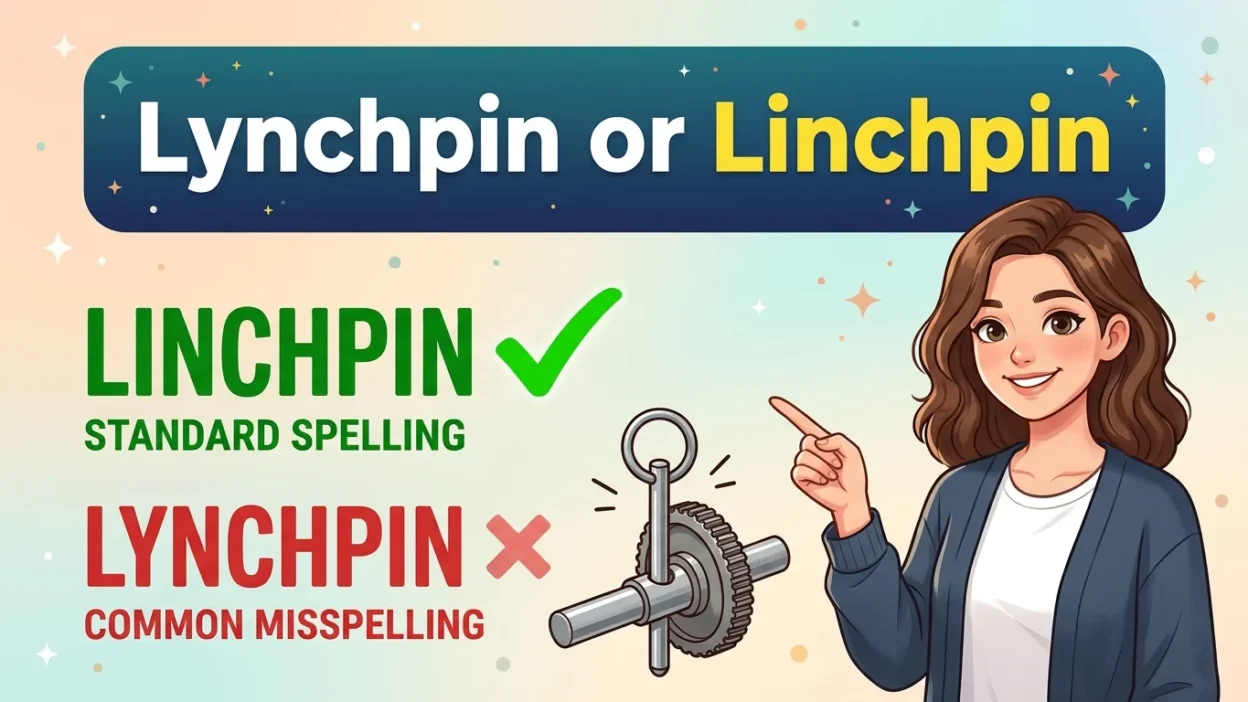
Have you ever wondered whether the correct spelling is lynchpin or linchpin? These two words look almost identical, and their similar pronunciation can make the choice confusing. However, only one is the standard spelling in modern English.
The correct word is linchpin, which refers to something or someone essential to the success, stability, or operation of a person, group, or system. For example, you might describe an important employee as the linchpin of a successful team. The alternative spelling, lynchpin, appears in some writing, but it is generally considered a nonstandard variant.
Understanding this difference helps you avoid spelling mistakes in professional emails, academic assignments, articles, and everyday communication. In this guide, you’ll learn the correct spelling, discover what linchpin means, explore its origin, and see practical examples that show how to use it naturally in a sentence.
Quick Answer :
The standard spelling is linchpin.
Linchpin is the preferred spelling in modern English and is the form you should generally use in formal writing, academic work, business communication, articles, and professional documents.
Lynchpin is a recognized variant spelling, but it is less common. If you want the safest and most widely accepted form, choose linchpin.
| Spelling | Status | Recommended? |
| Linchpin | Standard/common spelling | ✅ Yes |
| Lynchpin | Variant spelling | ⚠️ Less preferred |
So, if you are asking, “Is it lynchpin or linchpin?”, the simple answer is:
Use “linchpin” in most situations.
What Does Linchpin Mean?
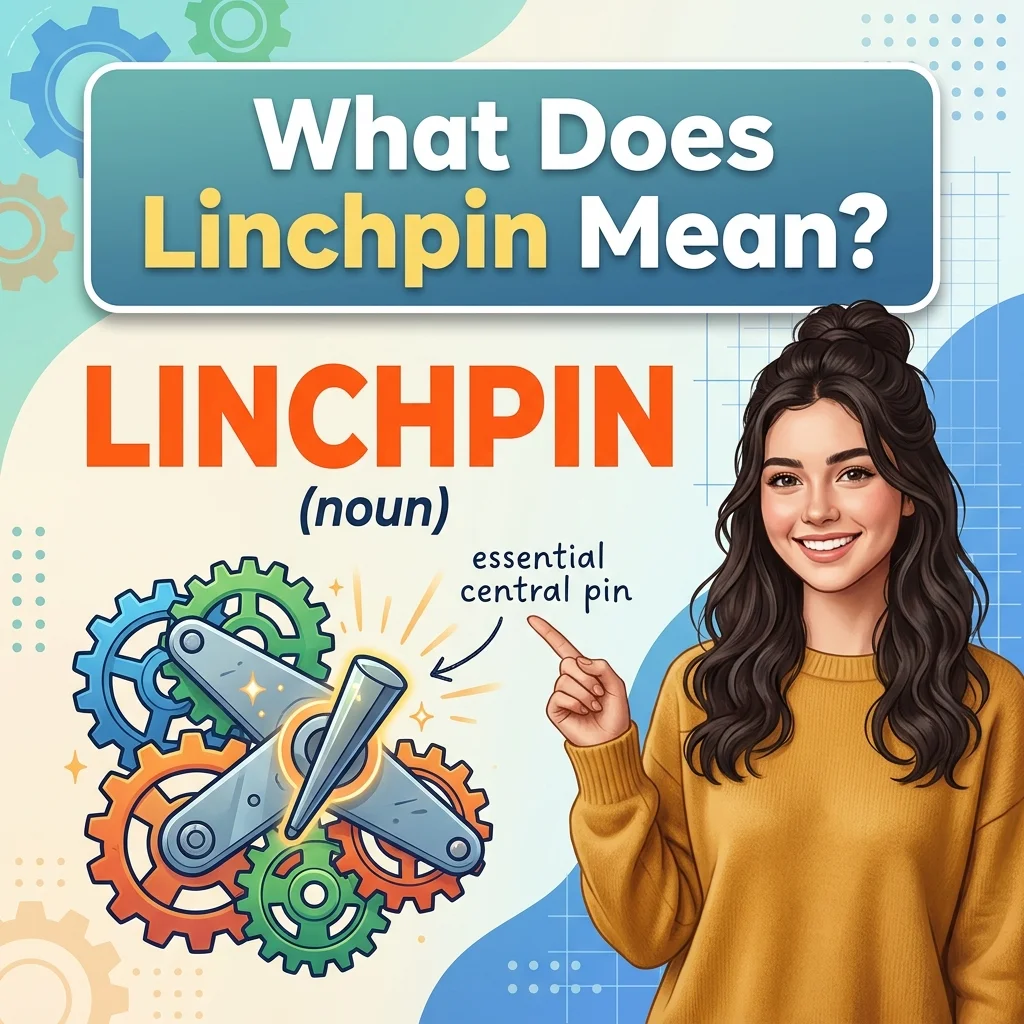
The noun linchpin has both a literal and a figurative meaning.
Originally, a linchpin was a small pin used to secure a wheel or another mechanical component. It helped keep the parts together and prevented a wheel from coming loose.
The modern figurative meaning developed from this physical function.
Today, linchpin usually refers to a person or thing that is extremely important to the success, operation, or stability of something.
Linchpin as a Person
When linchpin describes a person, it means that the person is essential to a group, organization, project, or situation.
For example:
- “Maria is the linchpin of the marketing team.”
- “The coach considers the goalkeeper a linchpin of the defense.”
- “James became the linchpin of the project.”
- “She has become a linchpin in the company’s growth.”
In each sentence, the person plays an especially important role.
Linchpin as a Thing or Idea
A linchpin does not have to be a person. It can also be an idea, agreement, strategy, component, decision, or factor.
For example:
- “Trust is the linchpin of a successful friendship.”
- “The new software is the linchpin of the company’s digital strategy.”
- “Communication is the linchpin of effective teamwork.”
- “The agreement became the linchpin of the negotiations.”
Here, linchpin means something essential that supports or holds a larger system together.
What Does Lynchpin Mean?
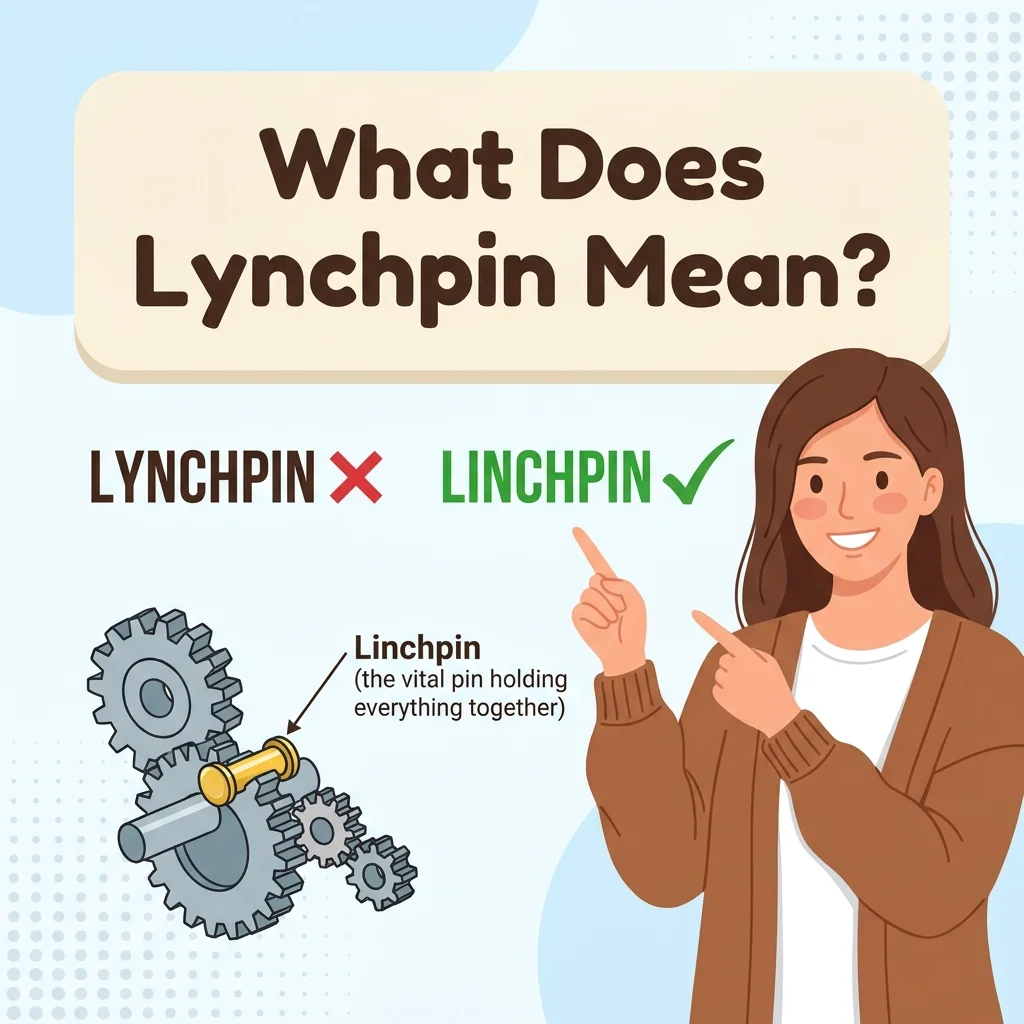
Lynchpin is a variant spelling of linchpin.
It generally carries the same meaning. When someone writes lynchpin, they usually intend to describe a person or thing that is essential to a situation.
For example:
- “He was the lynchpin of the organization.”
- “Communication became the lynchpin of the project.”
- “The manager was the lynchpin of the department.”
However, lynchpin is less commonly preferred than linchpin.
If you are writing something where spelling matters, such as a school assignment, professional report, website article, or formal email, linchpin is usually the better choice.
Why Is It Spelled Linchpin?
The spelling can seem strange because many people naturally associate the word with lynch.
However, linchpin comes from an older mechanical term referring to a pin used to hold a wheel in place.
The word has historical connections to forms such as linch pin, linch-pin, and related terms. Over time, linchpin became established as the common modern spelling.
The spelling lynchpin likely developed partly because people connected the pronunciation with the familiar spelling pattern lynch.
This is a useful reminder that English spelling does not always follow pronunciation perfectly.
Is Linchpin One Word or Two?
The modern spelling is generally written as one word: linchpin.
You may occasionally encounter older or historical forms such as linch pin or linch-pin, but linchpin is the normal modern form.
Correct
- linchpin
- the linchpin of the team
- a key linchpin
- an important linchpin
Less common or historical forms
- linch pin
- linch-pin
For modern everyday and professional writing, stick with linchpin.
Linchpin vs. Lynchpin: Main Difference
The biggest difference between linchpin and lynchpin is not their meaning. Both can refer to something or someone essential.
The difference is mainly spelling and usage frequency.
Linchpin is the standard spelling you are most likely to see in modern dictionaries, edited publications, professional writing, and formal contexts.
Lynchpin is a variant spelling that appears in English but is less common.
Think of it this way:
Linchpin = preferred standard spelling
Lynchpin = accepted variant, but less common
If you are unsure which one to use, choose linchpin.
Linchpin or Lynchpin: Comparison Table
| Feature | Linchpin | Lynchpin |
| Meaning | An essential person or thing | An essential person or thing |
| Standard usage | More common | Less common |
| Modern spelling | Preferred | Variant |
| Formal writing | Recommended | Usually avoid if a standard form is preferred |
| Business writing | Recommended | Less preferred |
| Academic writing | Recommended | Less preferred |
| Meaning difference | None in normal usage | None in normal usage |
The important point is that choosing linchpin does not change the meaning. It simply follows the more common spelling convention.
How to Use Linchpin in a Sentence
The word linchpin is a noun. It normally refers to a person or thing that has a crucial role.
One common sentence structure is:
[Person/Thing] + is + the linchpin + of + [something].
For example:
“Good communication is the linchpin of a successful business.”
Another common structure is:
[Person/Thing] + became + the linchpin + of + [something].
For example:
“The new manager became the linchpin of the department.”
You can also use adjectives before linchpin.
Examples include:
- a crucial linchpin
- an important linchpin
- a central linchpin
- a key linchpin
- the main linchpin
However, be careful with unnecessary repetition. Since linchpin already means something important, phrases such as “the most essential linchpin” may sound excessive depending on the context.
Linchpin Examples in Everyday English
Here are some simple examples to make the meaning easier to understand.
Example 1
“Tom is the linchpin of our team.”
This means Tom plays a vital role in keeping the team successful or organized.
Example 2
“Trust is the linchpin of their relationship.”
Here, trust is the essential element that supports the relationship.
Example 3
“The manager became the linchpin of the new project.”
This means the project relies heavily on the manager.
Example 4
“Technology has become a linchpin of modern education.”
Technology is being described as an important part of modern education.
Example 5
“The agreement was the linchpin of the entire plan.”
The agreement was a crucial element that helped the plan work.
Linchpin Examples in Business
You will often encounter linchpin in business writing because companies frequently discuss important people, systems, strategies, and processes.
For example:
“Effective leadership is the linchpin of a successful organization.”
“Customer trust remains a linchpin of the company’s reputation.”
“The logistics department is a linchpin of the business.”
“This partnership could become a linchpin of the company’s expansion strategy.”
“Reliable communication is the linchpin of remote teamwork.”
In business English, linchpin often communicates the idea that something is not merely useful but essential to the overall system.
Linchpin Examples in Academic Writing
The word can also appear in essays, research papers, and academic discussions.
For example:
“Education is often considered a linchpin of social development.”
“Accurate data collection is a linchpin of reliable research.”
“Public trust can serve as a linchpin of effective institutions.”
“Communication became a linchpin of the study’s collaborative process.”
However, academic writing should always prioritize clarity. Do not use linchpin simply to make a sentence sound sophisticated. Use it when you genuinely mean that something is central or essential.
Linchpin Examples in Relationships
The word can also describe an important part of a personal relationship.
For example:
“Honesty is the linchpin of a healthy relationship.”
“Mutual respect became the linchpin of their friendship.”
“Communication is often the linchpin of a strong marriage.”
In these examples, linchpin emphasizes that the relationship depends heavily on a particular quality.
Linchpin Examples in Technology
Technology provides many natural contexts for the word.
For example:
“Cybersecurity is a linchpin of modern digital infrastructure.”
“The database is the linchpin of the application.”
“Cloud computing has become a linchpin of many digital businesses.”
“Reliable internet access is a linchpin for remote work.”
These examples show that a linchpin can be a system, technology, process, or component rather than a person.
Is Lynchpin Wrong?
Not necessarily.
Calling lynchpin completely “wrong” would be too strong because the spelling is found as a variant in English. However, it is less common than linchpin, and linchpin is the safer choice for standard modern writing.
If you see lynchpin in a sentence, you can usually understand it as another spelling of linchpin.
For example:
“She was the lynchpin of the team.”
The intended meaning is clear: she was essential to the team.
Still, if you are writing the sentence yourself, use:
“She was the linchpin of the team.”
This avoids unnecessary spelling uncertainty.
Why Do People Spell It Lynchpin?
There are several reasons people may write lynchpin instead of linchpin.
One reason is pronunciation. Depending on accent and speech speed, the word can sound like it contains the familiar lynch spelling.
Another reason is familiarity. Many English speakers already know words such as lynch, lynching, and names containing “Lynch.” This can make lynchpin look more natural than the less familiar linchpin.
There is also the fact that lynchpin has appeared in published English, which reinforces the spelling for readers who encounter it.
However, frequency does not necessarily make it the preferred spelling.
Common Mistake: Using Lynch Instead of Linch
One of the most common spelling mistakes is writing:
❌ “The manager was the lynchpin of the team.”
A more standard version is:
✅ “The manager was the linchpin of the team.”
If you are learning the word for formal writing, remember:
LINCHPIN = preferred spelling
A simple memory trick is to connect the word with its original mechanical meaning: a linchpin helps hold a wheel or structure together.
Common Mistake: Writing Linch Pin
Another mistake is separating the word:
❌ “She is the linch pin of the organization.”
Modern standard usage generally prefers:
✅ “She is the linchpin of the organization.”
Although separated and hyphenated historical forms can be found, linchpin is the form you should normally use today.
Common Mistake: Using Linchpin for Any Important Thing
Although linchpin means something essential, not everything important is necessarily a linchpin.
Compare these sentences:
“The meeting was important.”
This simply says the meeting mattered.
“The meeting was the linchpin of the entire negotiation.”
This makes a much stronger claim. It means the meeting was central to the success or outcome of the negotiation.
Therefore, use linchpin when you want to communicate central importance or dependence, not merely general importance.
Common Mistake: Confusing Linchpin With Lynch
The word lynch has an entirely different meaning from linchpin.
Lynch is a verb associated with killing someone illegally, especially by a mob, while linchpin is a noun meaning an essential person or thing.
These words should not be confused.
For example:
“She is the linchpin of the project.”
Here, linchpin has nothing to do with the verb lynch.
This distinction is especially important because the similar spelling can create an unintended association.
Linchpin as a Metaphor
The modern use of linchpin is largely metaphorical.
Imagine a wheel attached to a vehicle. Many different parts work together, but a small pin can help keep the wheel securely attached.
If that small component is removed, the larger system can fail.
The figurative meaning works in a similar way.
A person, idea, or component can be called a linchpin when it holds an important system together.
For example:
“Communication is the linchpin of the project.”
The sentence does not mean communication is literally a metal pin. It means communication plays a central role in keeping the project functioning successfully.
Synonyms for Linchpin
If you want to avoid repeating linchpin, several alternatives can work depending on the context.
Common synonyms
- essential part
- key element
- crucial component
- central figure
- vital factor
- cornerstone
- foundation
- backbone
- main support
- driving force
- pivotal factor
- critical component
However, these words are not always exact substitutes.
For example, cornerstone often emphasizes a foundational idea, while linchpin emphasizes something that holds a larger system together.
Example
“Trust is the linchpin of their partnership.”
Possible alternatives include:
“Trust is the cornerstone of their partnership.”
“Trust is a crucial element of their partnership.”
The general idea remains similar, but the emphasis can change slightly.
Linchpin vs. Cornerstone
These two words are sometimes confused because both can describe something extremely important.
A linchpin is something essential to the functioning or success of a larger system.
A cornerstone is something that forms a fundamental basis or foundation.
For example:
“Communication is the linchpin of the project.”
This suggests communication keeps the project functioning.
“Trust is the cornerstone of their relationship.”
This suggests trust forms the foundation of the relationship.
Both are useful words, but they create slightly different images.
Linchpin vs. Backbone
Backbone can also mean an essential supporting part.
For example:
“Small businesses are the backbone of the local economy.”
This means small businesses provide major support to the economy.
By contrast:
“Reliable transportation is the linchpin of the delivery system.”
This suggests transportation is a critical element that allows the system to work.
The words overlap, but linchpin often emphasizes a particular element that is crucial to the success of a larger system.
Linchpin vs. Keystone
Keystone is another related word.
A keystone is the central wedge-shaped stone in an arch. Figuratively, it refers to something that holds a system or structure together.
For example:
“Education is a keystone of economic development.”
You can also say:
“Education is a linchpin of economic development.”
Both can work, although the metaphor and emphasis are slightly different.
Is Linchpin a Noun?
Yes.
Linchpin is a noun.
It names a person, thing, factor, idea, or component that is essential to something.
Examples:
- “She is the linchpin of the team.”
- “Trust is the linchpin of their relationship.”
- “The database is a linchpin of the system.”
You generally do not use linchpin as a verb.
Can Linchpin Describe a Person?
Yes.
This is one of the most common modern uses.
For example:
“David is the linchpin of the department.”
This means David plays an essential role in the department.
You can use the word for:
- a manager
- a teacher
- a team member
- a leader
- an employee
- a coach
- a specialist
- a founder
The person does not have to be the official leader. They simply need to play a role that is crucial to the larger group or system.
Can Linchpin Describe an Object?
Yes.
A physical object, tool, technology, system, or component can be a linchpin.
For example:
“The central database is the linchpin of the software system.”
“The bridge is a linchpin of the region’s transportation network.”
“The new payment system became a linchpin of the online store.”
Here, the word emphasizes the object’s importance to a larger operation.
Can Linchpin Describe an Idea?
Absolutely.
Abstract concepts are frequently described as linchpins.
For example:
“Trust is the linchpin of a successful partnership.”
“Transparency is a linchpin of good governance.”
“Innovation is a linchpin of the company’s strategy.”
In these examples, the word describes an abstract concept that plays a central role.
Singular and Plural Forms of Linchpin
The singular form is:
linchpin
The plural form is:
linchpins
Examples:
“Communication is a linchpin of the organization.”
“Several linchpins helped keep the project moving.”
The plural form simply adds -s.
Singular
- one linchpin
- the linchpin
- a linchpin
Plural
- several linchpins
- important linchpins
- multiple linchpins
Is Linchpin Formal or Informal?
Linchpin is suitable for both general and formal English.
You can use it in:
- conversations
- articles
- business writing
- academic writing
- reports
- presentations
- professional emails
- journalism
However, because it is somewhat figurative, a simpler expression such as key part or essential element may be better for very basic communication.
For example:
“Communication is the key part of the project.”
is simpler than:
“Communication is the linchpin of the project.”
Both can be correct. The second sounds more polished and metaphorical.
British and American English Usage
Linchpin is used in both British and American English.
There is no major US-versus-UK spelling difference that requires you to change the word.
For example, American English can use:
“She is the linchpin of the organization.”
British English can use:
“She is the linchpin of the organisation.”
Notice that the noun linchpin stays the same. The spelling difference appears in organization/organisation, not in linchpin.
How to Remember the Correct Spelling
If you frequently confuse lynchpin and linchpin, try this simple memory trick:
Think: “Linch holds things together.”
The word linchpin contains linch, which you can associate with the idea of something holding a wheel or structure together.
So remember:
LINCHPIN = the standard spelling
You can also write it several times:
linchpin
linchpin
Once you become familiar with the word, its spelling will start to look natural.
Lynchpin or Linchpin in SEO and Online Writing
If you are writing online content, linchpin is generally the spelling to use when discussing this word.
For example, a grammar article should use:
“Is it lynchpin or linchpin?”
and explain that linchpin is the more common standard spelling.
Avoid repeatedly using both forms simply to target search variations. Natural writing matters more than forcing a keyword into every paragraph.
You can mention lynchpin where it is genuinely relevant, especially when explaining the spelling variation.
Quick Spelling Guide
Here is an easy reference:
Preferred:
✅ linchpin
Variant:
⚠️ lynchpin
Modern one-word form:
✅ linchpin
Plural:
✅ linchpins
Historical/separated form:
⚠️ linch pin
If you need one spelling for everyday and professional writing, choose linchpin.
More Example Sentences With Linchpin
Here are additional examples from different contexts.
Workplace
“The project coordinator is the linchpin of the entire team.”
Education
“Teachers are a linchpin of a successful education system.”
Technology
“Data security is a linchpin of the platform.”
Sports
“The midfielder became a linchpin of the team’s strategy.”
Family
“Her grandmother was the linchpin of the family.”
Friendship
“Honesty has always been the linchpin of their friendship.”
Business
“Customer loyalty is a linchpin of the brand’s long-term success.”
Government and society
“Public trust can be a linchpin of effective institutions.”
Project management
“Clear communication became the linchpin of the project.”
Personal development
“Consistency is often a linchpin of long-term progress.”
Frequently Asked Questions About Lynchpin or Linchpin
Is “linchpin” or “lynchpin” correct?
Linchpin is the preferred standard spelling. Lynchpin is a recognized variant, but it is less common. For formal and professional writing, linchpin is the safer choice.
Is lynchpin a misspelling of linchpin?
It is better described as a variant spelling rather than simply an incorrect spelling. However, linchpin is more widely used and generally preferred in modern standard English.
What does linchpin mean?
A linchpin is a person or thing that is essential to the success, stability, or operation of something. For example, “Communication is the linchpin of teamwork.”
Is linchpin one word?
Yes. Linchpin is normally written as one word in modern English.
Can a person be called a linchpin?
Yes. A person can be called a linchpin when they play a crucial role in a team, organization, project, or other situation.
Can linchpin refer to an idea?
Yes. Abstract ideas such as trust, communication, cooperation, and transparency can be described as linchpins when they are essential to a larger situation.
What is the plural of linchpin?
The plural is linchpins.
For example:
“Several employees became linchpins of the organization.”
Is linchpin formal English?
Yes. Linchpin works well in professional, academic, business, and general writing. It is also common in everyday discussions.
What is another word for linchpin?
Depending on the context, alternatives include key element, crucial component, cornerstone, backbone, central figure, vital factor, and essential part.
Why do people write lynchpin?
People may write lynchpin because of pronunciation, familiarity with the spelling “lynch,” or exposure to the variant spelling. Nevertheless, linchpin is the preferred spelling for most modern writing.
Is “linch pin” correct?
Linchpin is the modern standard one-word form. Older texts may use “linch pin” or “linch-pin,” but you should normally write linchpin today.
What is the easiest way to remember linchpin?
Remember that linchpin is the standard spelling. Think of the original mechanical meaning: a small pin helped hold a wheel securely in place.
Final Thought :
When comparing lynchpin or linchpin, the correct and widely accepted spelling is linchpin. It refers to a person, thing, or element that holds something together or plays an essential role in its success. Although lynchpin is sometimes used as an alternative spelling, it is generally considered a misspelling.
If you want your writing to look professional, clear, and grammatically correct, always choose linchpin. Whether you are writing an academic paper, business article, email, or everyday message, using the standard spelling will help you communicate accurately. Remember, linchpin is the preferred spelling to use in modern English.

Daniel Carter is a passionate writer who creates clear, helpful, and easy-to-understand content. He focuses on language, grammar, word meanings, and everyday expressions, helping readers find simple answers to common questions.