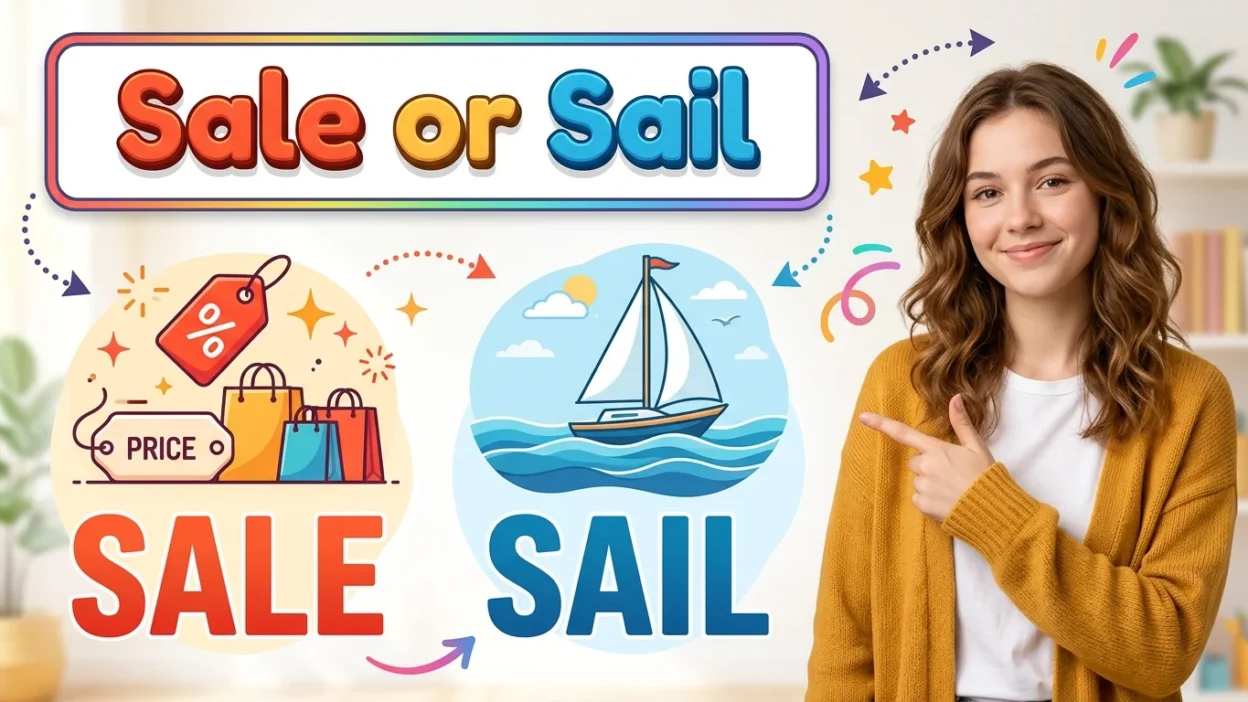
Have you ever written “sale” when you meant “sail”? These two words sound exactly alike, but they have completely different meanings and uses. This makes sale’ or ‘sail a common English spelling confusion, especially for beginners and English learners.
Although sale and sail are pronounced the same in standard English, they belong to different word categories and describe completely different ideas. Sale usually relates to selling something, especially at a reduced price. Sail, on the other hand, is connected with boats, ships, and traveling across water.
Understanding the difference between these words can help you write more accurately in emails, school assignments, social media posts, shopping content, and everyday conversations.
Quick Answer :
Sale is a noun that usually means the act of selling something or an occasion when products are offered at reduced prices.
Sail can be a noun or a verb. As a noun, it refers to a sheet of material that catches wind and moves a boat or ship. As a verb, it means traveling across water by boat or ship.
| Word | Part of Speech | Main Meaning | Example |
| Sale | Noun | An event or act of selling | The store has a big sale. |
| Sail | Noun/Verb | A boat’s sail or traveling by water | We will sail across the lake. |
The easiest way to remember
Think of sale when you are buying or selling something.
Think of sail when you are on a boat or ship.
- Sale = shopping and selling
- Sail = boats and water
What Does Sale Mean?

Sale is a noun that refers to the process of selling something. It can also describe a special period when a store offers products at lower prices.
For example:
The shoes are on sale.
This means the shoes are being offered for purchase, usually at a reduced price.
Another example is:
The company announced the sale of its old building.
Here, sale refers to the act of selling the building to someone else.
The word sale is extremely common in everyday English. You will often see it in stores, advertisements, online shopping websites, newspapers, and business communication.
Sale as a Reduced-Price Event
One of the most common meanings of sale is a period when products are sold at discounted prices.
For example:
- The store is having a summer sale.
- I bought this jacket during the sale.
- The shoes are on sale this week.
- There is a huge sale at the shopping mall.
- Many products are available at lower prices during the sale.
In these examples, sale refers to a shopping promotion or discount event.
Sale as the Act of Selling
Sale can also mean the actual process of transferring something to another person in exchange for money.
For example:
The sale of the house was completed yesterday.
Here, sale means the transaction in which the house was sold.
You might also see expressions such as:
- the sale of a car
- the sale of a house
- the sale of property
- the sale of a business
- the sale of shares
Common Expressions With Sale
Several common English expressions use sale.
On Sale
On sale usually means something is available for purchase at a reduced price.
These shirts are on sale today.
However, in some contexts, on sale can simply mean something is available for purchase rather than necessarily discounted. Context determines the exact meaning.
For Sale
For sale means something is available for someone to buy.
My old bicycle is for sale.
This does not necessarily mean the bicycle has been discounted. It simply means the owner wants to sell it.
Sale Price
A sale price is the price offered during a sale.
The original price was $80, but the sale price is $50.
Clearance Sale
A clearance sale is usually held to sell remaining stock, often at reduced prices.
The store is having a clearance sale before closing.
Big Sale
A big sale means a sale involving significant discounts or many products.
The website is advertising a big sale this weekend.
What Does Sail Mean?

Sail has a completely different meaning from sale.
As a noun, a sail is a large piece of material attached to a boat or ship. Wind pushes against the sail and helps move the vessel through the water.
For example:
The boat has a large white sail.
Here, sail refers to the piece of material used to catch the wind.
As a verb, sail means to travel across water using a boat or ship.
For example:
We sailed across the lake.
In this sentence, sailed is the past tense of sail.
Sail as a Noun
As a noun, sail refers to the material attached to a boat’s mast.
Examples include:
- The boat’s sail is torn.
- The wind filled the sail.
- The ship has three large sails.
- We watched the white sail disappear over the horizon.
- The sailor repaired the broken sail.
The word can also appear in compound expressions such as sailboat and sailing ship.
Sail as a Verb
As a verb, sail means to travel by boat or ship.
For example:
They sailed around the island.
Here, sailed tells us that they traveled around the island by boat.
More examples include:
- We sail every summer.
- They sailed across the ocean.
- She loves to sail on weekends.
- The ship will sail tomorrow morning.
- We are sailing along the coast.
Different Forms of Sail
The verb sail changes form depending on the tense.
| Form | Example |
| Sail | We sail every weekend. |
| Sails | The ship sails at dawn. |
| Sailed | They sailed across the sea. |
| Sailing | We are sailing toward the island. |
Remember that sail is the base form, while sailed and sailing are different forms of the same verb.
Sale vs Sail: What’s the Difference?
The main difference between sale and sail is their meaning.
Sale is related to selling, shopping, prices, and business transactions.
Sail is related to boats, ships, water, wind, and traveling across water.
They sound alike, but their meanings are completely different.
| Feature | Sale | Sail |
| Pronunciation | Usually /seɪl/ | Usually /seɪl/ |
| Meaning | Selling or discounted shopping | Boat travel or a boat’s cloth |
| Word type | Mainly noun | Noun and verb |
| Related to | Money, shopping, business | Boats, ships, water |
| Example | The store has a sale. | We will sail tomorrow. |
Sale Examples
I bought this shirt during the sale.
The store’s winter sale starts tomorrow.
Their house is for sale.
The company completed the sale of the property.
Sail Examples
We plan to sail across the lake.
The ship has a huge sail.
They sailed along the coast.
The wind filled the sail.
Why Do Sale and Sail Sound the Same?
Sale and sail are homophones.
A homophone is a word that sounds the same as another word but has a different meaning and spelling.
For example:
- sale / sail
- right / write
- sea / see
- flower / flour
- pair / pear
Because sale and sail have the same pronunciation, it is easy to confuse them when writing.
However, their spelling gives you a useful clue.
Sale contains “sale”, which is connected to selling.
Sail contains “sail”, which is connected to sailing.
How to Remember Sale vs Sail
A simple memory trick can make this distinction much easier.
Sale = Selling
Both sale and sell begin with the letters sal.
Think:
Sale → Sell → Shopping
For example:
The store has a sale.
Sail = Ship
Think of a sail attached to a boat.
The boat has a sail.
So you can remember:
Sale = money
Sail = boat
This simple association works well when you are unsure which spelling to use.
Sale or Sail in a Sentence
The surrounding words usually tell you which word is correct.
If the sentence talks about:
- prices
- stores
- buying
- selling
- discounts
- products
- property
- business
you probably need sale.
If the sentence talks about:
- boats
- ships
- oceans
- lakes
- wind
- sailing
- traveling by water
you probably need sail.
Compare these sentences:
The store is having a sale.
The boat has a white sail.
The pronunciation is the same, but the context makes the meaning clear.
Common Mistakes With Sale and Sail
Because these words are homophones, people sometimes use the wrong spelling.
Mistake: “The store has a big sail.”
If you mean a shopping promotion, this is incorrect.
Correct:
The store has a big sale.
A sail is associated with a boat, not a shopping promotion.
Mistake: “We will sale across the ocean.”
This is incorrect because sale is not the verb for traveling by boat.
Correct:
We will sail across the ocean.
Mistake: “The boat has a large sale.”
If you mean the fabric that catches the wind, the correct word is sail.
Correct:
The boat has a large sail.
Mistake: “The house is for sail.”
This is a common spelling error.
Correct:
The house is for sale.
The expression for sale means that something is available to buy.
Sale or Sail: Common Phrases
Learning common phrases can help you remember the difference naturally.
Common Phrases With Sale
- on sale
- for sale
- sale price
- sales event
- clearance sale
- annual sale
- seasonal sale
- public sale
- private sale
- final sale
- sale agreement
- sale proceeds
Examples:
These shoes are on sale.
Is this car for sale?
The sale price is $40.
Common Phrases With Sail
- sail a boat
- sail across the ocean
- sail across a lake
- sail around the world
- set sail
- sail away
- sailing boat
- sailing ship
- sailboat
- large sail
Examples:
The crew decided to set sail at sunrise.
They hope to sail around the world.
The boat has a new sail.
What Does “Set Sail” Mean?
Set sail is a common English expression meaning to begin a journey by boat or ship.
For example:
The ship will set sail at dawn.
This means the ship will begin its journey at dawn.
You can also use it figuratively in some contexts to describe starting a journey or adventure.
For example:
After finishing university, she set sail on a new adventure.
Here, the phrase has a more imaginative meaning. It does not necessarily mean that she literally traveled by boat.
What Does “For Sale” Mean?
For sale means that something is available for someone to buy.
For example:
This car is for sale.
It means the owner wants to sell the car.
Other examples include:
The house next door is for sale.
These paintings are for sale.
The old furniture is for sale.
Do not write for sail when you mean that an item is available to buy.
What Does “On Sale” Mean?
On sale commonly means that a product is being offered at a lower price than usual.
For example:
This laptop is on sale for $500.
This tells us that the laptop is currently being offered at that sale price.
Examples:
These shoes are on sale this week.
The restaurant’s gift cards are on sale.
Many winter clothes are on sale after the season ends.
Can Sail Be a Noun and a Verb?
Yes.
Sail can function as both a noun and a verb.
As a noun:
The boat’s sail was damaged.
Here, sail names an object.
As a verb:
We sail every Saturday.
Here, sail describes an action.
This is an important difference because sale is generally used as a noun, while sail can be both a noun and a verb.
Can Sale Be a Verb?
No, sale is not normally used as the verb meaning “to sell.”
The correct verb is sell.
Incorrect:
I will sale my car.
Correct:
I will sell my car.
This creates another common confusion because sale, sell, and sail sound or look somewhat similar.
Remember:
- Sell = the action of giving something to someone for money.
- Sale = the event or transaction involving selling.
- Sail = travel by boat or the material used to catch wind.
Sale, Sell, and Sail Compared
These three words are worth learning together.
| Word | Meaning | Example |
| Sell | To exchange something for money | I want to sell my car. |
| Sale | An act of selling or discounted shopping event | The car is on sale. |
| Sail | To travel by boat or a boat’s fabric | We will sail across the lake. |
Sell
Sell is a verb.
They want to sell their house.
Sale
Sale is mainly a noun.
The sale of the house was completed.
Sail
Sail can be a noun or verb.
The boat has a sail.
We will sail tomorrow.
Examples of Sale in Everyday English
Here are several natural examples:
- The store has a weekend sale.
- I found this jacket on sale.
- Is your old phone for sale?
- The company announced the sale of its building.
- The sale price is lower than expected.
- We waited for the annual sale.
- Everything is on sale today.
- The shop is holding a clearance sale.
- The house has been put up for sale.
- The final sale was completed last Friday.
Examples of Sail in Everyday English
Here are examples showing how sail works:
- We love to sail on the lake.
- The ship will sail tomorrow.
- They sailed across the ocean.
- The boat has a beautiful white sail.
- The wind filled the sail.
- We watched the ship sail away.
- She learned how to sail last summer.
- The crew prepared to set sail.
- The damaged sail needs to be replaced.
- They are sailing toward the island.
Sale vs Sail in Different Contexts
Context is one of the easiest ways to choose the correct word.
Shopping Context
Use sale.
The store is having a huge sale.
I bought the shoes during the sale.
Business Context
Use sale when talking about a transaction.
The sale of the company was completed last month.
Property Context
Use sale.
The apartment is for sale.
Ocean Travel Context
Use sail.
They will sail across the Atlantic.
Boat Equipment Context
Use sail.
The boat’s sail is damaged.
Adventure Context
Use sail if the journey happens by boat.
We plan to sail around the island.
Spelling Tips for Sale and Sail
Spelling can be easier if you connect each word with another related word.
Remember Sale With Sell
Sale → Sell
Both relate to buying and selling.
The store has a sale.
They sell clothes.
Remember Sail With Sailing
Sail → Sailing
Both relate to boats and water.
We sail on weekends.
We enjoy sailing.
When you see words such as boat, ship, ocean, lake, wind, mast, or sea, think sail.
When you see words such as price, store, discount, buy, sell, product, or shopping, think sale.
A Simple Trick for English Learners
When you hear /seɪl/, do not immediately choose a spelling.
First, ask yourself:
“What am I talking about?”
If you are talking about a store, product, price, or transaction, choose sale.
If you are talking about a boat, ship, water, or traveling by water, choose sail.
For example:
The shoes are on ___.
The sentence is about shopping, so the answer is sale.
We will ___ across the lake.
The sentence is about traveling by boat, so the answer is sail.
This technique is useful because pronunciation alone cannot tell you which spelling is correct.
Practice: Sale or Sail?
Try filling in the blanks before checking the answers.
- The store is having a big ___.
- We will ___ across the lake tomorrow.
- Is this house for ___?
- The boat’s ___ is very large.
- I bought this jacket during the ___.
- They plan to ___ around the island.
- The company announced the ___ of the property.
- The ship will ___ at sunrise.
Answers
- sale
- sail
- sale
- sail
- sale
- sail
- sale
- sail
If you got all eight correct, you have a good understanding of the difference.
Sale or Sail: Quick Grammar Test
Use sale if you can replace the word with something related to selling, shopping, or a transaction.
Use sail if you can replace it with travel by boat or the material on a boat that catches wind.
For example:
The store is having a ___.
You could say:
The store is having a shopping event.
So the answer is sale.
Now:
We are going to ___ across the sea.
You could say:
We are going to travel by boat across the sea.
So the answer is sail.
FAQs About Sale or Sail
Is it “sale” or “sail”?
Both words are correct, but they have different meanings. Sale relates to selling or discounted shopping, while sail relates to boats, ships, and traveling across water.
Are sale and sail pronounced the same?
Yes. In standard English, sale and sail are homophones. They generally have the same pronunciation but different spellings and meanings.
Is “for sale” or “for sail” correct?
For sale is correct when you mean that something is available to buy.
The car is for sale.
For sail would only make sense if you were literally talking about something intended for a boat’s sail.
Is it “on sale” or “on sail”?
When talking about a discounted product, the correct phrase is on sale.
These shoes are on sale.
On sail is not the normal expression for a discount.
Is “sale” a noun or a verb?
Sale is primarily a noun. It refers to an act of selling or an event where goods are offered for purchase, often at reduced prices.
Is “sail” a noun or verb?
Sail can be both a noun and a verb. As a noun, it refers to part of a boat or ship. As a verb, it means to travel by boat or ship.
What is the difference between sell and sale?
Sell is a verb, while sale is a noun.
I want to sell my car.
The sale of my car was completed yesterday.
Can I say “I will sale my car”?
No. The correct sentence is:
I will sell my car.
Sale is not the standard verb used in place of sell.
What does “set sail” mean?
Set sail means to begin a journey by boat or ship.
The crew set sail early in the morning.
How can I easily remember sale and sail?
Remember:
Sale = sell
Sail = ship
If the sentence is about buying or selling, use sale. If it is about boats or water travel, use sail.
Are sale and sail homophones?
Yes. They are commonly classified as homophones because they have the same pronunciation but different spellings and meanings.
Final Thoughts
The difference between sale and sail is simple once you connect each word with its meaning. They sound alike, but they belong to completely different areas of English. Use sale when you are talking about selling, shopping, prices, discounts, or business transactions.
For example, you can say, “The store is having a big sale” or “The house is for sale.” Use sail when you are talking about boats, ships, water travel, or the material that catches wind on a boat. For example, you can say, “We will sail across the lake” or “The boat has a large sail.”

Michael Collins is a skilled writer who creates clear, practical, and reader-friendly content. He focuses on language, grammar, word meanings, and everyday expressions, making complex topics simple to understand.