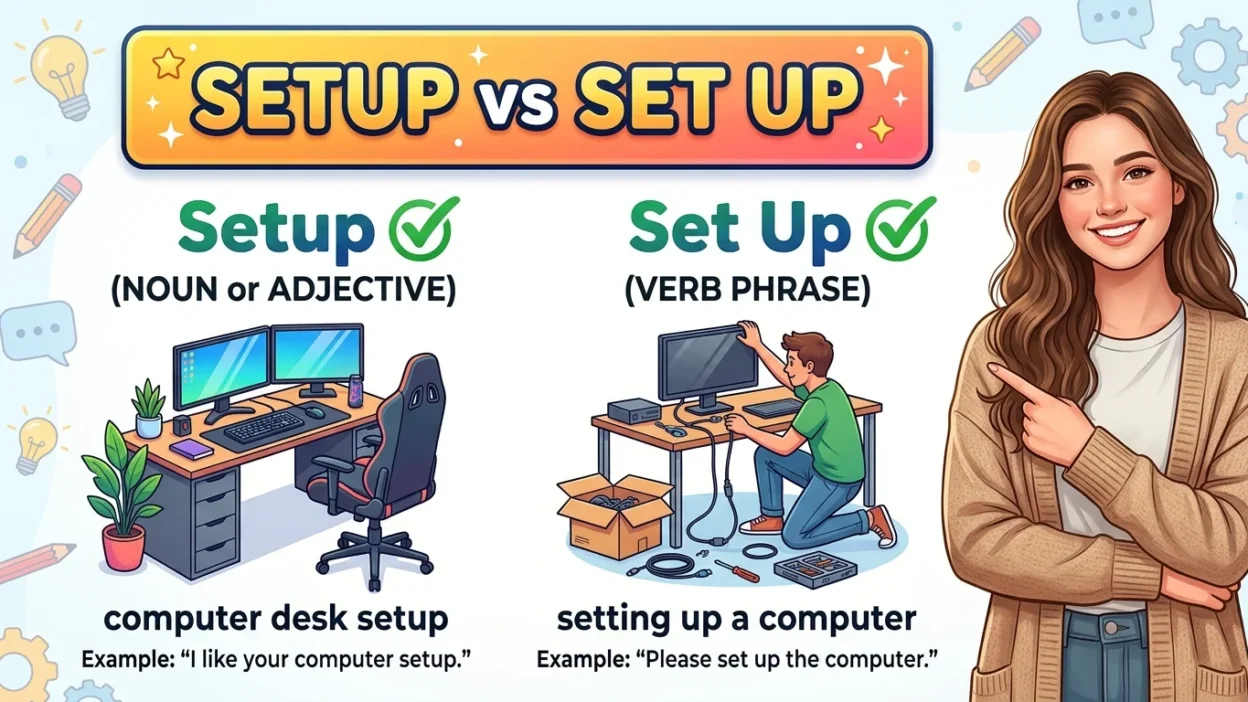
The words setup and set up look almost identical, but they serve different grammatical purposes. Knowing when to use each form can help you write clearer sentences and avoid common English mistakes. Setup is a noun or adjective that describes an arrangement, configuration, or the way something is organized.
For example, “Your computer setup looks great.” On the other hand, set up is a phrasal verb that means to arrange, establish, prepare, or install something. For instance, “I need to set up my new computer.” Although the difference may seem small, using the wrong form can affect the accuracy of your writing.
This guide explains setup vs set up with simple definitions, practical examples, and easy grammar rules. You’ll also learn how to recognize each form in everyday conversations, emails, instructions, and professional writing so you can use them confidently.
Quick Answer:
The easiest way to remember the difference is this:
- Setup = usually a noun or adjective describing an arrangement, system, equipment, or configuration.
- Set up = a verb meaning to arrange, prepare, establish, install, or organize something.
- Set-up = a hyphenated form that may appear in some writing styles, especially when used as a noun or adjective, but setup is very common in modern English as a noun.
Compare these sentences:
The computer setup looks great.
Here, setup is a noun. It refers to the arrangement or configuration of the computer.
I need to set up the computer.
Here, set up is a verb. It describes the action of preparing the computer.
A useful trick is to ask yourself: Am I talking about a thing or an action?
If you are talking about a thing, arrangement, system, or configuration, setup is often correct. If you are talking about an action, set up is usually correct.
What Does Setup Mean?

Setup is most commonly used as a noun. It refers to the way something is arranged, organized, configured, or prepared.
It can describe physical equipment, a computer system, a workspace, an event arrangement, a business arrangement, or even a situation.
For example:
My office setup is very simple.
The word setup refers to the arrangement of the office.
Another example is:
The gaming setup includes two monitors and a powerful computer.
Here, setup means the complete arrangement of the equipment.
The word can also describe a situation or arrangement created for a particular purpose.
For example:
The meeting setup allowed everyone to see the presentation clearly.
In this sentence, setup refers to how the meeting space was arranged.
Setup as a Noun
The most important use of setup is as a noun.
A noun names a person, place, thing, or idea. Since setup can name an arrangement or configuration, it can function as a noun.
Examples include:
- a computer setup
- a home office setup
- a gaming setup
- a camera setup
- a studio setup
- a classroom setup
- a business setup
- a security setup
- a network setup
- a temporary setup
Look at these examples:
I like your desk setup.
The new office setup is much more comfortable.
We changed the room setup before the event.
Her photography setup includes three lights.
In each sentence, setup names an arrangement.
Setup as an Adjective
Setup can also appear before another noun to describe something related to configuration or preparation.
For example:
The setup process took about an hour.
Follow the setup instructions carefully.
The setup guide explains each step.
In these examples, setup modifies another noun.
Some style guides may prefer different constructions depending on the context. However, setup is widely used as a noun and as a modifier in modern English, particularly in technical and everyday writing.
What Does Set Up Mean?

Set up is a phrasal verb. It means to arrange, prepare, establish, install, organize, or put something into a usable position.
Because set up is a verb, it normally describes an action.
For example:
I will set up the new printer tomorrow.
The action is preparing the printer so it can be used.
Another example:
They set up the tables before the event.
The people performed an action by arranging the tables.
Set Up as a Verb
The most common meaning of set up is to prepare or arrange something.
Examples:
Please set up the chairs.
Can you set up my new laptop?
We need to set up the equipment before the show.
She set up a meeting with her manager.
They set up a small business together.
The meaning changes slightly depending on the context, but the basic idea remains the same: something is being arranged, prepared, installed, or established.
Setup vs Set Up: The Main Difference
The key difference between setup and set up is grammatical.
Setup is generally a noun.
Set up is a verb.
Consider this pair:
The setup is complicated.
I need to set up the system.
In the first sentence, setup is a thing or arrangement. In the second sentence, set up is an action.
This distinction works in many situations.
| Word | Grammar | Main Meaning | Example |
| setup | Noun | Arrangement or configuration | The computer setup is excellent. |
| set up | Verb | Arrange or prepare something | I will set up the computer. |
| set-up | Noun/adjective in some styles | Arrangement or preparation | The set-up was completed quickly. |
The most useful rule is:
If you can replace the word with “arrangement” or “configuration,” use “setup.”
If you can replace it with “arrange,” “prepare,” “install,” or “establish,” use “set up.”
Setup vs Set Up Examples
Seeing the difference in complete sentences makes the rule much easier to understand.
Example 1: Computer
My computer setup is in the bedroom.
Here, setup means the arrangement of the computer equipment.
I need to set up my new computer.
Here, set up means the action of preparing the computer.
Example 2: Office
I love my new office setup.
Setup is a noun describing the arrangement.
I need to set up my office before Monday.
Set up is a verb describing the action.
Example 3: Meeting
The meeting setup was comfortable.
The sentence describes the arrangement of the meeting.
We need to set up the meeting room.
The sentence describes the action of arranging the room.
Example 4: Camera
Your camera setup looks professional.
The sentence refers to the equipment arrangement.
I will set up the camera before the interview.
The sentence refers to the action of preparing the camera.
Example 5: Business
The company’s current setup is quite efficient.
Here, setup refers to the company’s arrangement or structure.
They plan to set up a new company.
Here, set up means establish.
How to Know When to Use Setup
Use setup when you need a noun that refers to an arrangement, configuration, system, or situation.
A simple test is to ask:
“What is the arrangement?”
If the word answers that question, setup may be the correct choice.
For example:
I like your gaming setup.
What do you like? The gaming arrangement.
The studio setup is impressive.
What is impressive? The studio arrangement.
We changed the classroom setup.
What did we change? The classroom arrangement.
Common Phrases With Setup
You will often see setup in phrases such as:
- computer setup
- gaming setup
- office setup
- desk setup
- home setup
- camera setup
- studio setup
- network setup
- equipment setup
- workspace setup
- business setup
- security setup
Examples:
My desk setup helps me stay organized.
The new network setup is faster.
His gaming setup includes a large monitor.
We need a better workspace setup.
How to Know When to Use Set Up
Use set up when you are describing an action.
It often means:
- arrange
- prepare
- organize
- install
- establish
- create
- place something in position
For example:
Please set up the projector.
This means “please prepare or arrange the projector.”
We need to set up the room.
This means “we need to arrange the room.”
She wants to set up an online store.
This means “she wants to establish or create an online store.”
Common Phrases With Set Up
You may see set up in phrases such as:
- set up a meeting
- set up an account
- set up a computer
- set up a phone
- set up a business
- set up equipment
- set up a system
- set up a room
- set up a camera
- set up a website
- set up a schedule
- set up a payment method
Examples:
I need to set up a new account.
Can you set up the microphone?
They want to set up a meeting for Friday.
She helped me set up my phone.
Setup or Set Up: A Simple Grammar Trick
Here is one of the easiest ways to remember the difference.
Try putting “the” before the word.
If the sentence works naturally, you may need the noun setup.
For example:
The setup is ready.
That sounds correct.
But:
I will the set up the computer.
That does not work.
Instead, you need:
I will set up the computer.
Another useful test is to put a pronoun before the phrase.
I will set it up.
This clearly shows that set up is functioning as a verb.
You would not say:
I will setup it.
That is incorrect.
Set Up Can Be Separated
One important feature of the phrasal verb set up is that it can often be separated by an object.
For example:
I will set up the computer.
You can also say:
I will set the computer up.
Both are grammatically correct.
Another example:
She set up the meeting.
You can also say:
She set the meeting up.
However, when the object is a pronoun, it normally goes between the verb and particle:
She set it up.
Not:
She set up it.
This is an important grammar point for learners of English.
More Examples
Please set up the printer.
Please set it up.
Another example:
They set up the equipment.
They set the equipment up.
Learning this pattern can help you recognize set up as a phrasal verb.
Setup vs Set Up in Different Tenses
Because set up is a verb, it can change according to tense.
The base form is:
set up
The past tense is:
set up
The past participle is also:
set up
This can sometimes confuse learners because the word set does not change.
Present Tense
I set up my computer every morning.
They set up the equipment before each event.
Past Tense
I set up the computer yesterday.
She set up the meeting last week.
Present Perfect
We have set up the new system.
They have set up the room.
Future
I will set up the camera tomorrow.
She will set up a new account.
Notice that setup as a noun does not change into a verb simply because the sentence is in the past.
For example:
The setup was simple.
Here, setup remains a noun.
Common Mistakes With Setup and Set Up
Many English learners make the same mistakes with these forms. Understanding them can prevent unnecessary grammar errors.
Mistake 1: Using “Setup” as a Verb
Incorrect:
I need to setup my laptop.
Correct:
I need to set up my laptop.
Why? Because the sentence describes an action. Therefore, you need the verb set up.
Mistake 2: Writing “Set Up” as a Noun
Incorrect:
I like your gaming set up.
In standard modern usage, when you mean the arrangement itself, setup is generally preferred.
Correct:
I like your gaming setup.
Mistake 3: Using “Setup” Before an Object as a Verb
Incorrect:
She will setup the meeting.
Correct:
She will set up the meeting.
The phrase needs to function as a verb.
Mistake 4: Confusing “Set Up” and “Set It Up”
Incorrect:
I will set up it.
Correct:
I will set it up.
When the object is a pronoun such as it, the pronoun normally comes between set and up.
Mistake 5: Assuming the Meaning Is Always Identical
Although setup and set up are closely related, they are not interchangeable in every sentence.
Compare:
The setup is ready.
and:
We need to set up the equipment.
The first describes a thing. The second describes an action.
Setup vs Set Up vs Set-Up
There is a third form worth knowing: set-up with a hyphen.
The hyphenated form appears in some dictionaries, style guides, and varieties of English, particularly in certain compound constructions. However, modern usage commonly uses setup as the noun and set up as the verb.
For most everyday writing, this is a useful approach:
- setup → noun
- set up → verb
- set-up → hyphenated form that may appear depending on style or context
For example:
The setup was easy.
We need to set up the system.
If you are following a particular publication’s style guide, dictionary, or house style, follow its preferred spelling.
Is Setup One Word?
Yes. Setup is commonly written as one word when it functions as a noun.
For example:
The office setup is excellent.
I changed my desk setup.
The new computer setup works well.
However, when the phrase functions as a verb, write it as two words:
I will set up the office.
We need to set up the computer.
A simple visual rule is:
Noun = setup
Verb = set up
Is Set Up Always Two Words?
When set up functions as the verb meaning arrange, prepare, establish, or install, it is written as two words.
Examples:
We need to set up the chairs.
He will set up a new account.
She helped me set up the software.
Do not write:
We need to setup the chairs.
In this use, setup is not the standard verb spelling.
Setup vs Set Up in American English
In American English, setup is widely used as a noun.
For example:
My home office setup is comfortable.
American English also commonly uses set up as the verb:
I need to set up my home office.
The distinction between the noun and verb forms remains important in American writing.
Setup vs Set Up in British English
British English also uses setup as a noun and set up as a verb.
For example:
The office setup has changed.
We need to set up the office.
British English may use some different vocabulary and style choices from American English, but this particular distinction is generally straightforward in both varieties.
Therefore, whether you are writing for a UK or US audience, the basic rule remains useful:
setup = noun
set up = verb
Setup vs Configuration
The noun setup is often similar to configuration, especially in technology.
For example:
My computer setup is simple.
This can mean the arrangement of the computer, monitor, keyboard, mouse, speakers, and other equipment.
Meanwhile:
My computer configuration is simple.
This can focus more specifically on the technical settings or components.
The two words can overlap, but setup is usually broader and more conversational.
Setup vs Arrangement
Setup and arrangement can also have similar meanings.
For example:
The room setup looks good.
The room arrangement looks good.
Both can describe how things are organized.
However, setup often sounds more natural when discussing equipment, systems, events, or practical configurations.
For example:
My gaming setup is ready.
This is much more natural than:
My gaming arrangement is ready.
Set Up vs Install
Set up and install can sometimes overlap, especially with technology.
For example:
I need to set up my new printer.
This can mean preparing the printer for use.
I need to install the printer software.
This specifically refers to putting software onto a device.
So, set up can describe the broader preparation process, while install often describes putting software or equipment into a usable system.
Set Up vs Establish
The verb set up can also mean establish or create something.
For example:
They set up a new company.
Here, set up means established or created.
Another example:
She set up a charity.
This means she established the organization.
In formal writing, establish may sound more formal:
She established a charity.
In everyday English, set up is very natural.
Set Up vs Arrange
Arrange and set up are sometimes interchangeable.
For example:
Please arrange the chairs.
Please set up the chairs.
Both can mean preparing the chairs in the desired position.
However, set up often suggests preparing something for a particular activity or purpose.
For example:
We need to set up the room for the presentation.
The phrase clearly suggests preparing the room for an event.
More Real-Life Examples of Setup
Here are additional examples showing how setup works as a noun.
His home office setup is perfect for remote work.
The restaurant has a simple seating setup.
I changed my monitor setup yesterday.
The security setup needs improvement.
Our new network setup is faster.
The camera setup took several hours.
Her study setup includes a large desk.
The classroom setup makes group work easier.
Their business setup is quite unusual.
The lighting setup made the photos look better.
In each sentence, setup refers to an arrangement, system, configuration, or structure.
More Real-Life Examples of Set Up
Now compare those examples with set up as a verb.
I need to set up my home office.
They will set up the tables.
She helped me set up the camera.
We need to set up a new network.
He wants to set up an online business.
Please set up the lights.
I will set up the presentation before lunch.
Can you set up my new phone?
They set up the classroom for the workshop.
We have to set up the security system.
Every example describes an action.
A Quick Test You Can Use
When you are unsure whether to write setup or set up, use this three-step test.
Step 1: Identify the Role
Ask:
Is this word naming something or describing an action?
If it names an arrangement, system, or configuration, choose setup.
If it describes arranging, preparing, or establishing something, choose set up.
Step 2: Look for an Object
If you see an object after the phrase, set up may be acting as a verb.
For example:
I will set up the computer.
The object is the computer.
Step 3: Try a Synonym
Replace the expression with another word.
If arrangement works:
My computer arrangement is excellent.
Then setup is probably correct.
If prepare or arrange works:
I need to prepare my computer.
Then set up is probably correct.
Setup vs Set Up: Memory Trick
Here is a simple mnemonic:
One word = one thing.
Think of setup as one complete arrangement or configuration.
Two words = an action.
Think of set up as something you actively do.
You can remember it like this:
The setup is ready.
I will set up the system.
The first sentence describes a thing.
The second sentence describes an action.
Another easy trick is to remember:
Setup = noun
Set up = verb
This short rule will solve most everyday usage questions.
Why This Difference Matters
You might wonder why such a small spelling difference matters. After all, the two expressions sound almost identical.
Grammar matters because readers understand words partly through their form and position. When you use the wrong form, your sentence can look careless or confusing.
For example:
We need to setup the room.
Most readers will understand what you mean, but the spelling is incorrect in standard usage.
Writing:
We need to set up the room.
is grammatically correct and looks more polished.
This becomes especially important in professional emails, academic writing, website content, instructions, and business communication.
Common Questions About Setup vs Set Up
Is “setup” one word or two?
Setup is one word when it functions as a noun. For example, “My computer setup is ready.”
When you use the phrase as a verb, write set up as two words. For example, “I will set up my computer.”
Is “set up” a verb?
Yes. Set up is a phrasal verb. It can mean to arrange, prepare, install, organize, establish, or create something.
For example:
We need to set up the equipment.
Is “setup” a noun?
Yes. Setup is commonly used as a noun meaning an arrangement, configuration, system, or situation.
For example:
The office setup is comfortable.
Which is correct: “setup a meeting” or “set up a meeting”?
The correct form is set up a meeting.
For example:
I need to set up a meeting with my manager.
Here, set up is a verb.
Which is correct: “computer setup” or “computer set up”?
When you mean the computer arrangement or configuration, computer setup is the standard choice.
For example:
My computer setup includes two monitors.
If you mean the action of preparing the computer, use set up:
I need to set up my computer.
Is “set-up” correct?
Set-up can be found in some English usage, particularly depending on the style guide or context. However, setup is very common as the noun, while set up is used for the verb.
For general modern writing, remember:
The setup is ready.
We will set up the equipment.
Can “set up” be separated?
Yes. When set up is used as a phrasal verb, it can often be separated by the object.
For example:
She set up the computer.
She set the computer up.
With a pronoun, use:
She set it up.
What is the past tense of “set up”?
The past tense is set up.
For example:
I set up the system yesterday.
The word set does not change in this form.
What is the difference between setup and setting up?
Setup is usually a noun referring to an arrangement or configuration.
Setting up is the -ing form of the verb set up and refers to the action or process.
Compare:
The setup is complete.
Setting up the equipment took an hour.
Can setup be used as an adjective?
Setup can appear before a noun as a modifier, especially in technical and everyday expressions such as setup instructions or setup process.
For example:
Read the setup instructions before using the device.
The exact preferred form can vary by style guide, so follow the conventions required by your publication or organization.
Setup vs Set Up: Final Comparison
| Feature | Setup | Set Up |
| Main grammatical role | Noun | Verb |
| Number of words | One | Two |
| Main meaning | Arrangement or configuration | Arrange or prepare |
| Example | The setup looks good. | Set up the equipment. |
| Can take an object? | Usually no, as a noun | Yes |
| Common in technology? | Yes | Yes |
| Common in everyday English? | Yes | Yes |
| Past form | Not applicable as a noun | Set up |
| Easy synonym | Arrangement | Arrange/prepare |
The difference becomes much clearer when you focus on grammar rather than spelling.
Practice: Choose Setup or Set Up
Try completing these sentences before checking the answers.
- I need to ___ my new laptop.
- His gaming ___ is impressive.
- We will ___ the room before the event.
- The office ___ looks comfortable.
- She wants to ___ an online store.
- The camera ___ took several hours.
- Please ___ the projector.
- I like your desk ___.
- They ___ the equipment yesterday.
- The new system ___ is easy to use.
Answers
- set up
- setup
- set up
- setup
- set up
- setup
- set up
- setup
- set up
- setup
If you got most of these right, you already understand the basic distinction.
Conclusion
Understanding setup vs set up does not have to be difficult. The two forms are closely related, but their grammatical jobs are different. Use setup as a noun when you are talking about an arrangement, configuration, system, or situation. For example, “My computer setup is ready.”
Use set up as a verb when you are talking about the action of arranging, preparing, installing, organizing, or establishing something. For example, “I need to set up my computer.”

Daniel Carter is a passionate writer who creates clear, helpful, and easy-to-understand content. He focuses on language, grammar, word meanings, and everyday expressions, helping readers find simple answers to common questions.