The words assume, presume, and infer are often confused because all three relate to how people understand information or reach conclusions. However, they have different meanings and aren’t always interchangeable. Assume means accepting something as true without having definite proof.
Presume also involves accepting something as likely true, but it often suggests that you have some reason or evidence to support your belief. Infer means reaching a conclusion based on facts, clues, or available information. For example, you might assume someone is busy, presume they’re at work based on their usual schedule, or infer they’re unavailable after seeing their calendar.
Understanding assume vs presume vs infer can help you communicate more accurately in conversations, academic writing, and professional situations. This guide breaks down each word with clear definitions, practical examples, and easy tips to help you choose the right one.
Quick Answer:
The easiest way to remember the difference is:
- Assume = believe something is true without definite proof.
- Presume = believe something is probably true based on reasonable evidence or expectation.
- Infer = reach a conclusion from evidence or information.
Here is a simple memory trick:
Assume = guess
Presume = reasonably expect
Infer = conclude from clues
For example:
- I assume Sarah is at home because her car is outside.
- I presume Sarah is at home because she usually works from home on Fridays.
- I infer that Sarah is at home because the lights are on, her car is outside, and she just posted from her living room.
The exact choice depends on how you know something and how certain the conclusion is.
What Does Assume Mean?
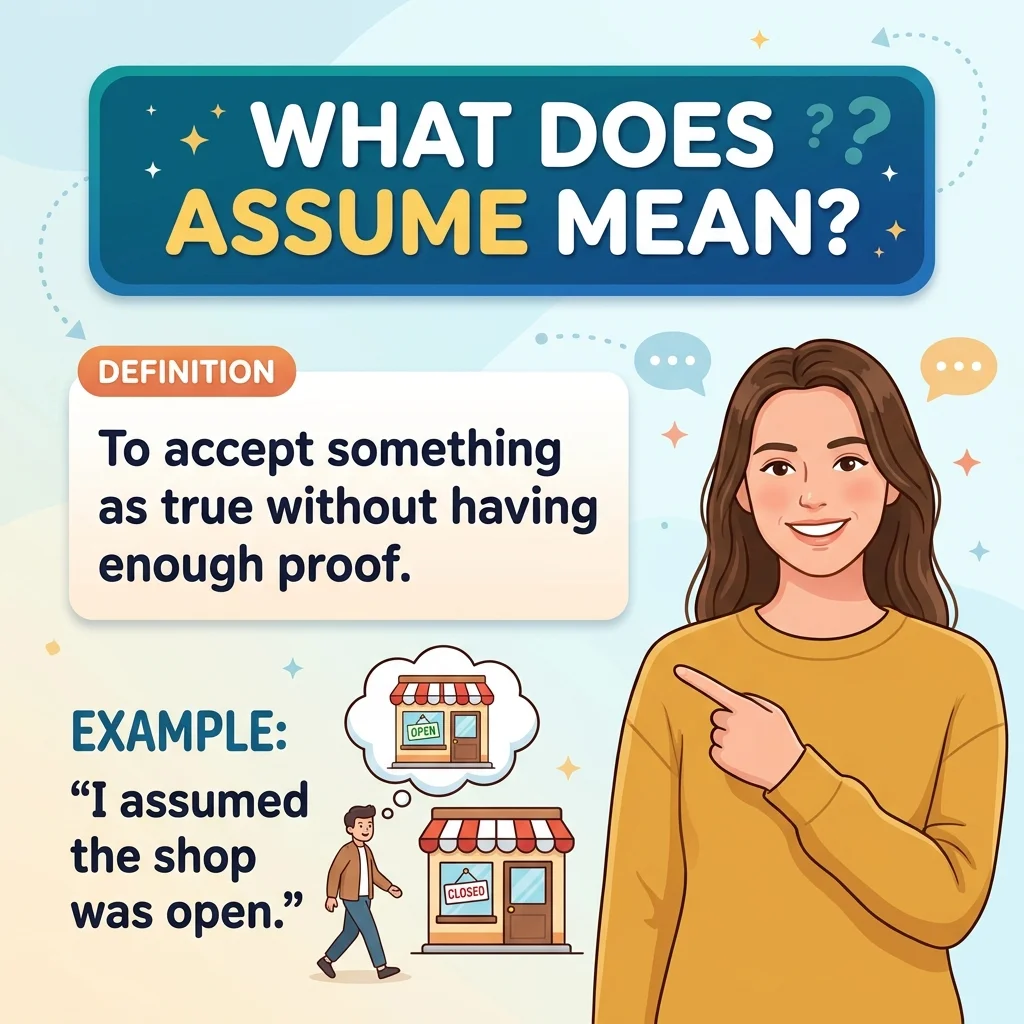
The verb assume means to accept or believe that something is true without having complete proof.
When you assume something, you make a mental decision about a situation. Sometimes your assumption is reasonable, but sometimes it can be completely wrong.
For example:
I assumed that the store was open because the lights were on.
You believed the store was open, but you did not actually check the opening hours or ask anyone.
Another example is:
I assumed you were tired because you went to bed early.
You are making a conclusion about someone’s condition without knowing for certain that they were tired.
The word assume is very common in everyday English. People use it when talking about expectations, guesses, beliefs, or things they accepted as true.
Assume Meaning in Simple English
In simple English, assume means:
To believe something is true without checking or having complete proof.
It does not always mean that your belief is unreasonable. You may have some information, but you still do not have enough evidence to be certain.
Examples of Assume
Here are some everyday examples:
- I assume you know the answer.
- She assumed that I was angry.
- We assumed the meeting would start at nine.
- Don’t assume that everyone agrees with you.
- I assumed he had already left.
- They assumed the restaurant would be open.
- He assumed that the package had arrived.
- I assume you have received my email.
- She assumed the test would be easy.
- We assumed they were coming with us.
In each example, the person accepts something as true without complete confirmation.
How to Use Assume Correctly

Assume can be followed by a noun, adjective, clause, or other structures.
A common structure is:
assume + that + clause
For example:
I assumed that he was busy.
Another common structure is:
assume + noun
For example:
We assumed responsibility for the project.
However, in the context of believing something, you will often see assume that.
Assume in Everyday Conversation
People frequently use assume when they talk about expectations.
For example:
I assume you’re coming to the party tonight.
This means the speaker believes the listener is coming, but they may not have confirmed it.
Another example:
I assumed you didn’t want coffee.
The speaker made a decision based on their understanding of the situation rather than asking directly.
This is why people sometimes say:
“Don’t assume.”
The phrase warns someone not to treat an unconfirmed belief as a fact.
What Does Presume Mean?
The verb presume means to believe that something is probably true based on reasonable evidence, expectation, or what is normally expected.
It is similar to assume, but it often suggests a stronger or more reasonable basis for the belief.
For example:
I presume the train has already left.
The speaker believes the train has left because the scheduled departure time has passed or because there is another reason to expect it.
Compare that with:
I assume the train has already left.
Both sentences can work, but presume can suggest that the speaker has a reasonable basis for the belief.
Presume Meaning in Simple English
In simple English:
Presume means to believe something is probably true because there is a reasonable reason to think so.
It can also mean to accept something as true until there is evidence that shows otherwise.
For example:
We presume that the information is correct unless someone proves otherwise.
Here, the belief is based on a normal expectation.
Examples of Presume
- I presume you have already eaten.
- We presume that the documents are accurate.
- I presume she knows about the meeting.
- The court may presume a person innocent until proven guilty.
- I presume they will arrive soon.
- She presumed that the offer was genuine.
- We presume the road is safe unless officials say otherwise.
- I presume you received the invitation.
- He presumed that everyone understood the instructions.
- They presumed the problem had been fixed.
Presume in Formal English
Presume often appears in formal, legal, academic, and professional contexts.
For example:
The law presumes a person innocent until proven guilty.
Another example:
We may presume that the results are accurate based on the available information.
In these situations, presume can sound more formal than assume.
That does not mean you should replace every instance of assume with presume. The words have overlapping meanings, but they are not interchangeable in every sentence.
What Does Infer Mean?
The verb infer means to reach a conclusion based on evidence, clues, information, or what someone has said.
This is the biggest difference between infer and the other two words.
When you infer something, you are not simply accepting an idea. You examine available information and use it to reach a conclusion.
For example:
The ground is wet, so I infer that it rained last night.
You did not necessarily see the rain. Instead, you used the wet ground as evidence and reached a conclusion.
Another example:
She didn’t say she was upset, but I inferred it from her tone of voice.
Her tone provided a clue.
Infer Meaning in Simple English
In simple English:
Infer means to figure something out from evidence or clues.
You can think of it as:
Evidence → Reasoning → Conclusion
For example:
The lights are off, the doors are locked, and there are no cars outside.
You might infer that the business is closed.
You are using several clues to reach a conclusion.
How to Use Infer Correctly
A common structure is:
infer + that + clause
For example:
I inferred that he was unhappy from his expression.
You can also use:
infer + something + from + evidence
For example:
We inferred the cause of the problem from the available data.
Another useful structure is:
infer + something + from + something
For example:
She inferred his feelings from his actions.
Examples of Infer
- I inferred that she was tired from her slow speech.
- We inferred the answer from the clues.
- He inferred that something was wrong.
- The detective inferred the suspect’s location from the evidence.
- I inferred that they were leaving because they started packing.
- She inferred his meaning from his facial expression.
- Scientists infer information from experimental results.
- From his silence, I inferred that he disagreed.
- The teacher inferred that the students needed more practice.
- We inferred the cause from the available evidence.
Assume vs Presume vs Infer: Main Difference
Now let’s compare the three words directly.
| Word | Basic Meaning | Evidence | Level of Basis | Common Use |
| Assume | Believe something is true | Little or no proof required | An expectation or belief | Everyday English |
| Presume | Believe something is probably true | Usually some reasonable basis | More reasoned expectation | Formal and everyday English |
| Infer | Reach a conclusion from evidence | Evidence or clues are important | Reasoning from information | Academic, professional, everyday English |
The key difference is how the person reaches the belief.
Assume: You accept something as true.
Presume: You believe something is likely true because there is a reasonable basis.
Infer: You use evidence or clues to reach a conclusion.
Assume vs Presume
The difference between assume and presume is often subtle because the two words overlap.
Both can mean believing something to be true without absolute certainty.
However, assume is generally broader and more common. Presume often suggests that the belief has a reasonable basis or follows from what is normally expected.
Compare these sentences:
I assumed he was at home.
This simply tells us that I believed he was at home.
I presumed he was at home because his car was outside.
This tells us that I had a reason for believing he was home.
However, context matters. In real-world English, the distinction is not always strict.
Assume vs Presume Examples
Example 1
I assumed that the office was closed.
The speaker believed it was closed, perhaps without checking.
I presumed that the office was closed because it was a public holiday.
The speaker had a reasonable reason for the belief.
Example 2
She assumed that he was angry.
She presumed that he was angry because he stopped talking to everyone.
Example 3
We assumed the event would be canceled.
This expresses an expectation.
We presumed the event would be canceled because the organizers had announced a severe weather warning.
This gives a reasonable basis.
Assume vs Infer
The difference between assume and infer is clearer.
When you assume, you accept an idea as true without necessarily using evidence to reach a conclusion.
When you infer, you use evidence or clues to reach a conclusion.
For example:
I assumed John was sick.
Maybe you simply believed he was sick.
I inferred that John was sick because he stayed home, missed work, and told me he had a fever.
The second sentence clearly shows evidence.
A Simple Way to Remember It
Think about a detective.
A detective should not simply assume that someone committed a crime.
Instead, the detective examines evidence and infers what happened.
For example:
The detective inferred that the suspect had entered through the back door because the lock was damaged and footprints led inside.
The conclusion comes from evidence.
Presume vs Infer
Presume and infer can also overlap, but their focus differs.
Infer focuses on how you reach a conclusion from evidence.
For example:
I presume that she is home.
You believe she is probably home.
I infer that she is home because her car is in the driveway and her lights are on.
The second sentence explains the evidence behind the conclusion.
Presume vs Infer Examples
Presume:
I presume the manager has approved the request.
The speaker expects that this is probably true.
Infer:
I inferred that the manager had approved the request because the order was processed.
The speaker uses the processed order as evidence.
Assume vs Presume vs Infer Examples
Let’s look at situations where all three words can appear.
Example 1: A Friend Is Not Answering
Imagine that you text your friend, but they do not reply.
You say:
I assume she’s busy.
You are making an unconfirmed belief.
You might say:
I presume she’s busy because she has an important meeting today.
Now there is a reasonable basis.
You could say:
I infer that she’s busy because she hasn’t checked her phone and her calendar shows a meeting.
Now you are reaching a conclusion from specific evidence.
Example 2: A Restaurant
You arrive at a restaurant and see that the lights are off.
You might assume it is closed.
Example 3: School
A student does not come to class.
You assume that the student is absent.
You presume that the student is absent because they usually attend but have not arrived by the start time.
The Difference in Certainty
It is useful to think about the three words in terms of reasoning rather than a strict scale of certainty.
Assume
An assumption can be based on little information.
I assumed the movie started at eight.
Maybe you did not check the schedule.
Presume
A presumption often has a reasonable basis.
I presumed the movie started at eight because that is the usual time.
You have a reason to expect it.
Infer
An inference comes from available evidence.
I inferred that the movie had started because people were already leaving the theater.
You observed a clue and reached a conclusion.
Remember that these are general distinctions. Context can change how each word sounds.
When to Use Assume
Use assume when you want to describe accepting something as true without complete confirmation.
It works well in everyday conversations.
For example:
I assume you know where the station is.
I assume they will arrive soon.
Don’t assume that I agree with you.
She assumed that the answer was correct.
It is also common in business and academic writing:
For this calculation, we assume that the temperature remains constant.
Here, assume does not mean a careless guess. It describes a condition accepted for the purpose of an argument, calculation, or discussion.
When to Use Presume
Use presume when something is believed to be true based on reasonable expectation, normal circumstances, or an accepted principle.
For example:
I presume you have read the instructions.
We presume that the information is accurate.
I presume they will contact us tomorrow.
The word can also have a legal or formal meaning.
For example:
The law may presume innocence until guilt is established.
In this type of sentence, presume has a specific formal sense.
When to Use Infer
Use infer when you draw a conclusion from information or evidence.
For example:
I inferred from his expression that he was surprised.
The researchers inferred that the treatment was effective from the results.
We can infer that the road is closed because there are barriers across it.
Whenever the idea is “I saw this information, and therefore I concluded that,” infer is often the right choice.
Common Mistakes With Assume, Presume, and Infer
Understanding the differences is easier when you know the mistakes learners commonly make.
Mistake 1: Using Infer for a Simple Guess
Incorrect:
I inferred that the store was open because I thought it was Monday.
If you simply believed the store was open without using evidence, assumed may be more appropriate.
Better:
I assumed that the store was open.
If you actually saw evidence, you can use infer:
I inferred that the store was open because people were shopping inside.
Mistake 2: Thinking Presume Means “Know”
Presume does not mean that you know something with complete certainty.
For example:
I presume he is at work.
This does not mean:
I know he is at work.
It means you believe that he is probably at work.
Mistake 3: Treating Assume and Infer as Exact Synonyms
They are not exact synonyms.
Assume focuses on accepting something as true.
Infer focuses on reaching a conclusion from evidence.
For example:
I assumed she was upset.
This does not tell us why.
I inferred she was upset from her tone.
This tells us that her tone provided evidence.
Mistake 4: Assuming Presume Is Always More Correct
Some learners think presume is simply a more formal version of assume.
That is not always true.
The two words can overlap, but their meanings have slightly different shades.
Use assume when you are simply accepting something as true.
Use presume when there is a reasonable expectation or accepted basis.
Mistake 5: Confusing Infer and Imply
This is one of the most common vocabulary mistakes.
Infer and imply describe different sides of communication.
The speaker or writer implies something.
The listener or reader infers something.
For example:
The manager implied that the project was delayed.
I inferred from the manager’s comments that the project was delayed.
The manager gives the suggestion. You draw the conclusion.
Infer vs Imply
This distinction is important in both everyday and academic English.
Imply
Imply means to communicate an idea indirectly rather than stating it clearly.
Example:
She implied that she did not like the proposal.
Infer
Infer means to understand or conclude something from what has been said or shown.
Example:
I inferred from her comments that she did not like the proposal.
A simple memory trick is:
Speaker → implies
Listener → infers
Grammar Patterns With Assume
Here are some useful structures.
Assume + That Clause
I assume that he is ready.
We assume that the information is correct.
Assume + Noun
They assumed responsibility for the project.
She assumed control of the company.
Here, assume has a different meaning related to taking responsibility, control, or a role.
Assume Something About Someone
Don’t assume anything about people based on appearances.
This structure is common when talking about beliefs or judgments.
Grammar Patterns With Presume
Presume + That Clause
I presume that you have finished the work.
They presumed that the information was accurate.
Presume Something
The court presumed his innocence.
Here, the structure uses a noun directly.
Presume Someone to Be
We presumed him to be the owner.
This structure is formal and less common in casual conversation.
Grammar Patterns With Infer
Infer + That Clause
I inferred that she was upset.
Infer Something From Something
We inferred the answer from the evidence.
Infer Something From What Someone Says
I inferred his meaning from what he said.
This pattern is particularly useful in reading comprehension and academic writing.
Assume vs Presume vs Infer in Academic Writing
These words are also important in academic writing.
Researchers, students, and writers often need to explain whether they are making an assumption, accepting a reasonable presumption, or drawing an inference from evidence.
For example:
For the purpose of this study, we assume that participants answered honestly.
This describes an assumption used in the study.
Another example:
We presume that the sample represents the larger population.
This expresses a reasonable expectation.
Now compare:
From the survey results, we infer that customer satisfaction increased.
The researchers are using results to reach a conclusion.
This distinction helps academic writing remain precise.
Assume vs Presume vs Infer in Business English
Business communication also uses all three words.
Consider a workplace situation.
I assume the client has received the proposal.
This means you believe the client received it, but you have not confirmed it.
I presume the client has received the proposal because the email was delivered successfully.
You have a reasonable basis.
I infer that the client has received the proposal because they replied to a point mentioned only in that document.
Now the evidence strongly supports the conclusion.
Choosing the right word can prevent misunderstandings in professional communication.
Assume vs Presume vs Infer in Everyday English
In casual conversation, assume is much more common.
You might say:
I assume you’re hungry.
I assume she is coming.
Presume can sound more formal in some everyday situations:
I presume you’re the new manager.
This sentence is perfectly natural, especially in formal or polite contexts.
Infer is also normal but often appears when discussing clues or conclusions:
I inferred from his message that he was upset.
Positive and Negative Examples
Understanding correct and incorrect usage can help you remember the difference.
Assume
Correct:
I assumed that you were busy.
Incorrect meaning if you intend to emphasize evidence:
I assumed from the security cameras that he entered the building.
Better:
I inferred from the security cameras that he entered the building.
Presume
Correct:
I presume the package will arrive tomorrow.
Less natural if you simply want to describe a casual guess:
I presume she’s probably watching TV.
In casual speech, I assume she’s watching TV may sound more natural.
Infer
Correct:
I inferred from the evidence that he had left.
Incorrect:
I inferred that he was home because I just guessed.
Better:
I assumed that he was home.
Spelling Tips: Assume, Presume, and Infer
These words have different spelling patterns.
Assume
Correct spelling:
assume
Not:
asume
Remember that assume has double s.
Related forms include:
- assume
- assumed
- assuming
- assumption
Notice the spelling change in assuming:
assume → assuming
The final e disappears before -ing.
Presume
Correct spelling:
presume
Not:
presum
Related forms include:
- presume
- presumed
- presuming
- presumption
Infer
Correct spelling:
infer
Related forms include:
- infer
- inferred
- inferring
- inference
Pay attention to inferred and inferring. The final consonant is doubled.
For example:
The writer inferred the meaning from context.
She was inferring his intentions from his behavior.
Assumption vs Presumption vs Inference
The noun forms are also useful.
Assumption
An assumption is something you accept as true without complete proof.
The plan is based on the assumption that sales will increase.
Presumption
A presumption is a belief that something is probably true based on reasonable grounds or an accepted principle.
There is a presumption that the information is accurate.
Inference
An inference is a conclusion reached from evidence or information.
The conclusion was based on an inference from the available data.
Compare:
Assumption = accepted belief
Presumption = reasonable expectation
Inference = evidence-based conclusion
A Simple Memory Trick
If you keep mixing these words up, remember this three-step formula:
Assume = Accept
You accept something as true.
I assume he is busy.
Presume = Expect
You expect something to be true because there is a reasonable basis.
I presume he is busy because he has a meeting.
Infer = Evidence
You use evidence to reach a conclusion.
I infer he is busy because his calendar shows a meeting and he has not responded.
This is not an absolute rule for every context, but it is an excellent starting point for English learners.
Assume vs Presume vs Infer: Side-by-Side Examples
| Situation | Assume | Presume | Infer |
| Friend is not answering | I assume she’s busy. | I presume she’s busy because she is working. | I infer she’s busy from her work schedule. |
| Store is closed | I assume the store is closed. | I presume it is closed because it’s after 10 p.m. | I infer it is closed because the doors are locked. |
| Student is absent | I assume he is absent. | I presume he is absent because class has started. | I infer he is absent because his seat is empty and his classmates haven’t seen him. |
| Package is delivered | I assume it arrived. | I presume it arrived because the delivery date has passed. | I infer it arrived because the tracking page says it was delivered. |
| Someone is upset | I assume she is upset. | I presume she is upset because she left early. | I infer she is upset from her tone and expression. |
The table shows how the reasoning changes.
Can Assume and Presume Be Used Interchangeably?
Sometimes, yes.
In many sentences, replacing assume with presume does not create a serious grammatical error.
For example:
I assume he knows the answer.
I presume he knows the answer.
Both are grammatically correct.
However, they can have different tones and implications.
Assume is usually more neutral and common.
Presume can suggest a reasonable expectation and may sound more formal.
Therefore, the choice depends on context, tone, and the amount of reasoning behind the belief.
Can Assume and Infer Be Used Interchangeably?
Usually, no.
The distinction is more important.
Assume does not require evidence.
Infer normally involves evidence or information.
For example:
I assumed that she was angry.
This simply describes your belief.
I inferred that she was angry from her tone.
This explains that you reached the conclusion by examining a clue.
Changing infer to assume can remove an important part of the meaning.
Can Presume and Infer Be Used Interchangeably?
Not always.
Presume focuses on believing something is probably true.
Infer focuses on reaching a conclusion from evidence.
For example:
I presume the meeting is finished.
This means you believe it is probably finished.
I inferred that the meeting was finished because everyone had left the room.
The second sentence shows the evidence behind the conclusion.
Why These Words Matter in English
Knowing the difference between assume, presume, and infer can make your English more precise.
Consider the difference between:
I assume he is guilty.
and:
I infer from the evidence that he may be responsible.
The first sentence presents a belief. The second emphasizes a conclusion based on evidence.
Similarly:
I presume the package has arrived.
shows a reasonable expectation, while:
I infer that the package has arrived because the tracking system says “delivered.”
shows evidence-based reasoning.
These differences matter in school, work, journalism, business, academic writing, and everyday conversations.
Frequently Asked Questions About Assume vs Presume vs Infer
Is assume the same as presume?
Not exactly. Assume and presume overlap, but assume is generally broader and more common. Presume often suggests that something is believed to be true because there is a reasonable basis or expectation.
What is the difference between assume and infer?
Assume means to accept or believe something without complete confirmation. Infer means to reach a conclusion from evidence, clues, or information.
For example:
I assumed he was tired.
I inferred he was tired from his slow speech and tired-looking eyes.
What is the difference between presume and infer?
Presume means to believe something is probably true based on reasonable expectation. Infer means to reach a conclusion from evidence or information.
Is presume more formal than assume?
Often, yes. Presume can sound more formal than assume, especially in legal, academic, or professional contexts. However, the words are not simply formal and informal versions of the same word.
Does infer mean guess?
Not exactly. Infer involves reaching a conclusion from evidence or clues. A guess may be made without evidence.
What is an easy way to remember assume, presume, and infer?
Remember:
Assume = accept
Presume = expect
Infer = evidence
This simple trick can help you choose the correct word.
Which is correct: “I assume that” or “I presume that”?
Both can be correct.
I assume that he is coming.
I presume that he is coming.
The first is more common in everyday English. The second can suggest a reasonable expectation and may sound more formal.
Which is correct: “I inferred that” or “I assumed that”?
Both can be correct, but they express different reasoning.
Use assumed when you accepted something as true without complete confirmation.
Use inferred when you reached the conclusion from evidence.
Can you infer without evidence?
Normally, inference involves some form of information, evidence, clues, or context. Without any basis at all, assume or guess is usually more appropriate.
What is the noun of assume?
The noun is assumption.
Example:
That was an incorrect assumption.
What is the noun of presume?
The noun is presumption.
Example:
The argument was based on a false presumption.
What is the noun of infer?
The noun is inference.
Example:
Her conclusion was a reasonable inference from the evidence.
Is “Don’t assume” grammatically correct?
Yes.
Don’t assume anything.
This is a common expression that tells someone not to treat an unconfirmed belief as fact.
Is “I presume” polite?
It can be. For example:
I presume you are Mr. Smith.
This can sound polite and formal. In casual conversation, however, I assume may be more natural depending on the situation.
What is the difference between inference and assumption?
An assumption is something you accept as true without complete proof. An inference is a conclusion you reach from evidence or information.
For example:
Assumption: I assume the road is open.
Inference: I infer that the road is open because cars are moving through it.
Conclusion :
The easiest way to understand these three words is to focus on the reasoning behind the statement. Assume means you accept something as true without complete confirmation. It is extremely common in everyday English and can also be used in academic, professional, and technical contexts.
Presume means you believe something is probably true because there is a reasonable basis, expectation, or accepted principle. It often has a more formal tone. Infer means you reach a conclusion from evidence, clues, information, or context. It focuses on the process of reasoning.

Emily Parker is a dedicated writer who enjoys creating clear, useful, and easy-to-understand content. She focuses on language, grammar, word meanings, and everyday expressions to help readers find simple and reliable answers.